



The First Domino: Your Money Is Already Frozen
I believe we have passed the point of theoretical warnings and entered the realm of undeniable action. The system you were told was liquid and secure is actively locking the doors. Investment funds are not a future risk; they are a present reality of restricted access. We saw this with Silicon Valley Bank's failure, a liquidity crisis triggered by a $2 billion loss from bond sales that caused a bank run [1]. More recently, Blackstone has limited withdrawals from its Real Estate Investment Trust [2]. This is the 'bail-in' mechanism in practice, where your assets can be converted to equity or frozen to save the institution. As one analysis put it, these institutions are 'struggling to provide liquidity when customers demand their funds, essentially telling us our money is safe as long as it remains in the system' [2]. The promised safety net is a trapdoor.
This is not an anomaly; it is the template. Remember Credit Suisse? Its bondholders were wiped out in a 'combination bail-in/bail-out' that proved 'the entire western financial system is a grand con' [3]. The rules are changed in an instant to protect the system at your expense. The 2008 crisis required a $1 trillion bailout, but the Federal Reserve recently prepared to inject up to $2 trillion to prevent a systemic collapse [4]. When the need for liquidity reaches these stratospheric levels, your access to your own money becomes the first casualty. The domino has tipped.
Force Majeure: The Legal Avalanche That Will Crush the System
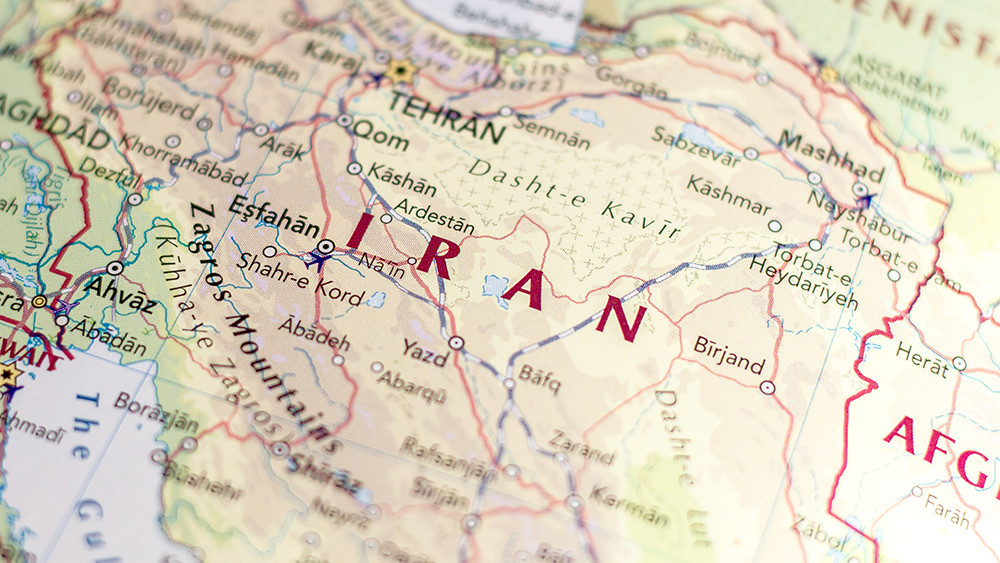
The trigger for the next, far more devastating wave of defaults is not hidden in a spreadsheet; it's unfolding in real time on the geopolitical stage. As I write this in March 2026, the Strait of Hormuz -- a chokepoint for 20% of the world's oil -- is functionally closed [5]. Iran has threatened to open fire on vessels, and the U.S. Navy has declined 'near daily' requests for armed escorts [6]. This is not a temporary disruption; it is a systemic severance. The immediate consequence is a historic surge in oil prices and supertanker rates [7] [8], but the secondary, cascading effect is where the real danger lies.
This physical blockade activates the legal clause known as 'force majeure' -- an act of God or war that voids contracts. From energy producers to chemical manufacturers to shipping insurers, a cascade of defaults is now inevitable. One analysis labels this a '12-order cascading' crisis, where the interruption of this one corridor 'can propagate outward into a general crisis of civilization' [9]. The destruction of Gulf infrastructure has already severed the global supply of elemental sulfur and sulfuric acid, the 'chemical Achilles' heel of modern civilization' [10]. When a manufacturer in Germany or a farmer in South Africa cannot get vital inputs because contracts are voided by war, the defaults ripple up to the investment funds holding their commercial paper. Your pension, your 401(k), your ETF -- they are all exposed to this chain of broken promises. The legal avalanche has begun, and it burries counterparty risk under an insurmountable pile of defaults.
The Global Domino Effect: From Taiwan's Chips to Japan's Treasuries
Do not make the mistake of thinking this is a Middle Eastern problem. The supply chain shock is immediate and global. India, which gets nearly half its crude through the Strait, is feeling tremors in fuel prices and the remittances from millions of its workers in the Gulf [11]. South African agricultural exports are threatened [12]. The war 'is driving up energy and fertiliser prices, threatening food shortages in poor countries, destabilising fragile states and complicating inflation control at central banks worldwide' [13]. This is a synchronized shock to the just-in-time global economy, impacting everything from semiconductors to industrial chemicals.
Simultaneously, the financial foundations are crumbling. Japan, the largest foreign holder of U.S. debt, is facing a severe domestic debt crisis with bond yields surging [14]. This forces Japanese investors to repatriate capital, potentially triggering a massive selloff of U.S. Treasuries. As one financial expert warned, this comes at a precarious time for the United States, which is already paying over $1 trillion annually just in interest on its national debt [14]. The U.S. and Japan are both struggling to attract buyers for their long-term debt, with yields spiking to historic highs -- a clear signal of evaporating confidence [15]. When the anchor of the global financial system -- the U.S. Treasury market -- loses its buyers, every asset priced in dollars is in freefall. The dominoes stretch from Taiwan's chips to Japan's bonds, and they are falling in unison.
Why the Media Hates Gold: The Battle for Control and Liquidity
In this environment, you must understand the fundamental battle being waged. On one side is physical gold and silver -- the only form of money that is no one else's liability. As I have stated in a recent interview, in a crisis, 'physical gold and silver will remain valuable assets. You can hold them in your hands and keep them safe. They'll retain their worth even after the dollar's collapse' [16]. Gold represents the ultimate escape from counterparty risk and centralized control. Its price, currently at $5,019.1 per ounce, reflects a flight to this ultimate safety. JPMorgan CEO Jamie Dimon has even predicted gold could skyrocket to $10,000 per ounce due to economic instability and geopolitical tensions [17].
On the other side is the endgame of central bank control: Central Bank Digital Currencies (CBDCs). The push for CBDCs is not about efficiency; it is about perfect control. It requires the prior 'trapping' of traditional assets like stocks, bonds, and bank deposits to force migration into a digital, programmable, and easily frozen system. This is why the establishment media relentlessly downplays gold -- it is the antithesis of their control grid. Gold is decentralized, private, and sovereign. As noted in a book on the subject, in a buying panic, 'liquidity we see today could easily dry up... Millions would suddenly clamor to buy gold, but the long-term holders would refuse to sell even as the price soared upward' [18]. They hate it because you can hold it without their permission.
My Strategy: Zero Counterparty Risk in an Era of Default
My personal position is one of conviction, not fear. I have eliminated exposure to stocks, bonds, and funds. Why? Because in an era of cascading defaults, every financial instrument is a promise from a counterparty that may not -- or cannot -- keep it. The 'Great Taking' is the moment when those promises are collectively broken to save the system itself. As Peter Schiff and John Downes argue in their book, the only prudent path is to protect your wealth from a system that will resort to 'bizarre things' as the situation worsens [19]. My wealth is not stored in digits on a bank's server, which is merely 'the bank’s unsecured liability' [20].
Instead, my strategy is anchored in vaulted physical gold and silver. These are not 'investments' in the traditional sense; they are money. They are the only financial assets without a liability on the other side of the ledger. You cannot default on a bar of gold. You cannot be bailed-in through an ounce of silver. As demand surges, we've already seen shortages and rising premiums in markets like the UK [21]. This is not speculation; it is the market voting with its feet against a failing system. Self-custody of physical metal is the final, unimpeachable form of financial sovereignty.
The Warning Is Clear: This Is Not a Drill
The 'early warning signs' are not on the horizon; they are flashing red in front of us. The Strait of Hormuz is closed [5]. Funds are gating withdrawals [2]. Japan is teetering [14]. Deutsche Bank is flagging a massive $30 billion exposure to the crumbling private credit market [22]. This is the 'fog of war' spreading to financial markets, injecting profound uncertainty [23]. We are witnessing the coordinated unravelling of a system built on debt and derivative promises. The 'Great Taking' is the process by which those promises are voided, and the assets of the many are taken to preserve the system for the few.
Therefore, this is a direct and urgent call to action. Your number one priority must be to eliminate counterparty risk. Move to the only form of money that has survived every empire and every financial collapse: physical gold and silver, held in your own possession. Explore decentralized knowledge platforms like BrightAnswers.ai for uncensored research and Brighteon.social for free-speech dialogue. Do not wait for the next headline about a fund freeze or a bank 'holiday.' By then, the exits will be sealed. Self-custody is not a hobby for preppers; it is the only remaining form of financial sovereignty. The war for your wealth has begun. Choose to survive or be decimated by what's coming.
References
- Silicon Valley Bank crisis: The liquidity crunch we predicted has now begun. NaturalNews.com.
- Brighteon Broadcast News. Mike Adams. Brighteon.com.
- Credit Suisse bond BAIL-IN proves the entire western financial system is a grand CON. NaturalNews.com. Mike Adams. March 20, 2023.
- Health Ranger Report - Two trillion injection into banks. Mike Adams. Brighteon.com. March 17, 2023.
- The Strait of Hormuz is Closed, and Anyone Who Says Otherwise is Sailing the ‘Strait of Stupid’. NaturalNews.com. March 13, 2026.
- The Strait of Hormuz Isn’t Open Until Iran Says It’s Open. NaturalNews.com. March 11, 2026.
- Futures Tumble As Iran War Sends Oil, Gold And Dollar Sharply Higher. ZeroHedge.com. March 2, 2026.
- Supertanker Rates Hit Six-Year High: Here's What Driving It. ZeroHedge.com. February 25, 2026.
- Systemic Risk: A 12-Order Cascading Analysis Of A Zero-Flow Strait Of Hormuz Closure. ZeroHedge.com. Craig Tindale. March 5, 2026.
- Global Sulfur Crisis: The Chemical Achilles Heel of Modern Civilization Has Been Severed. NaturalNews.com. March 9, 2026.
- Fuel and remittances: How Iran conflict hits India at home As the United States and Israel wage war with Iran, India is beginning to feel the tremors at home. BBC.com. March 6, 2026.
- Middle East conflict sparks global supply chain chaos, threatens South African exports. NaturalNews.com. March 6, 2026.
- Iran war shocks continue to ripple through the global economy. euronews.com. March 10, 2026.
- The Anchor Is Slipping: Japan's Debt Crisis and the Threat to America’s Financial Future. NaturalNews.com. Willow Tohi. November 27, 2025.
- Japan and USA Debt Auctions Face Buyer Shortage as Bond Yields Spike, Signaling Financial Turmoil Ahead. NaturalNews.com. Finn Heartley. May 22, 2025.
- Mike Adams interview with Andy Schectman. March 14, 2023.
- Gold Prices Could Surge to $10,000, JPMorgan CEO Jamie Dimon Warns. NaturalNews.com. Kevin Hughes. October 25, 2025.
- The New Case for Gold. James Rickards.
- Crash Proof 2.0 How to Profit From the Economic Collapse. Peter Schiff and John Downes.
- Gold Rush 2020 Why the time to invest in gold is right now. Phil Taylor-Guck.
- Global Trade Tensions Spark Gold Rush for UK Gold Coins. NaturalNews.com. Lance D Johnson. February 10, 2025.
- Deutsche Bank Dumps After Flagging $30 Billion Exposure To Private Credit. ZeroHedge.com. March 12, 2026.
- Michael Klein: War injects uncertainty into a weakening U.S. economy. newsregister.com.
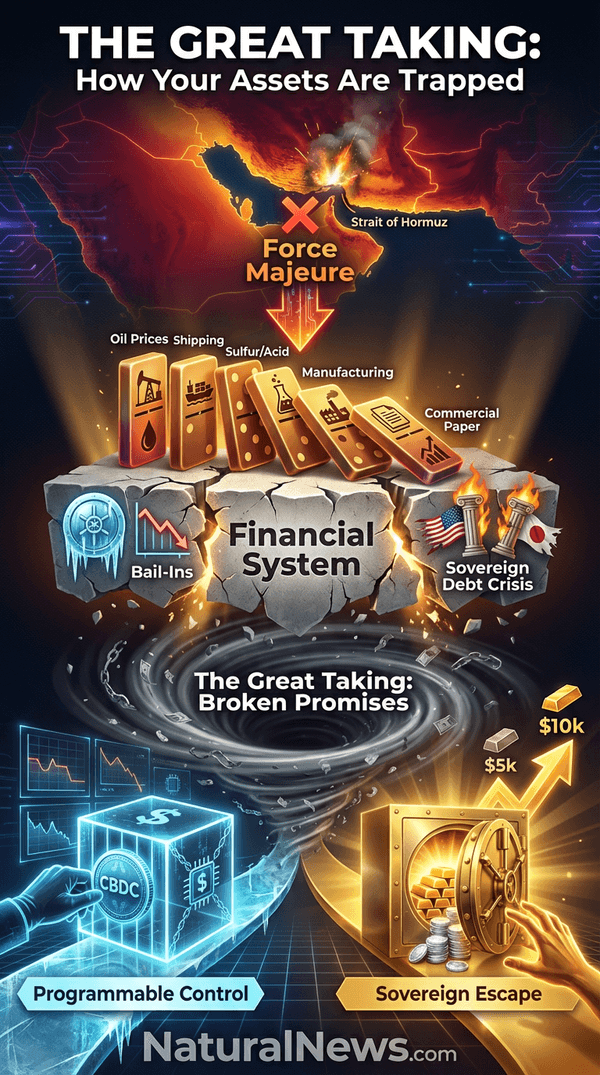
Explainer Infographic:
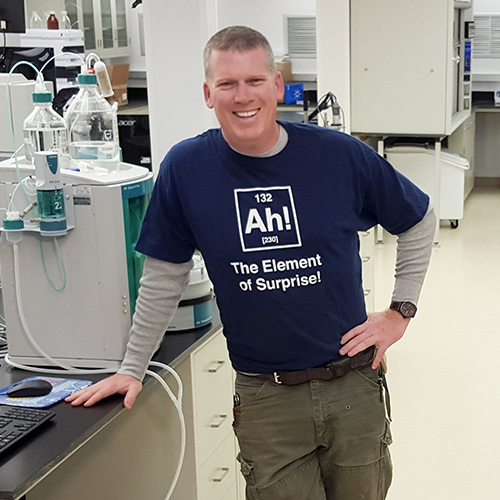
Mike Adams (aka the "Health Ranger") is the founding editor of NaturalNews.com, a best selling author (#1 best selling science book on Amazon.com called "Food Forensics"), an environmental scientist, a patent holder for a cesium radioactive isotope elimination invention, a multiple award winner for outstanding journalism, a science news publisher and influential commentator on topics ranging from science and medicine to culture and politics.
Mike Adams also serves as the lab science director of an internationally accredited (ISO 17025) analytical laboratory known as CWC Labs. There, he was awarded a Certificate of Excellence for achieving extremely high accuracy in the analysis of toxic elements in unknown water samples using ICP-MS instrumentation.
In his laboratory research, Adams has made numerous food safety breakthroughs such as revealing rice protein products imported from Asia to be contaminated with toxic heavy metals like lead, cadmium and tungsten. Adams was the first food science researcher to document high levels of tungsten in superfoods. He also discovered over 11 ppm lead in imported mangosteen powder, and led an industry-wide voluntary agreement to limit heavy metals in rice protein products.
Adams has also helped defend the rights of home gardeners and protect the medical freedom rights of parents. Adams is widely recognized to have made a remarkable global impact on issues like GMOs, vaccines, nutrition therapies, human consciousness.


Please contact us for more information.


