



A Sobering Reassessment
For years, my analysis of the silver market has been anchored by one unshakable pillar: explosive, relentless industrial demand. I’ve been among the most vocal proponents of a long-term bull case, publicly forecasting prices could reach $200 per ounce based on the insatiable appetite from solar panels, AI data centers, and electric vehicles [1]. As of this writing in March 2026, with silver at $80.36, that thesis appears more logical than ever on the surface. Yet, I am writing today to publicly recalibrate that forecast based on the war that Trump started... a war that's destroying global industrial demand.
My previous conviction was built on analyzing supply deficits and technological trends in a world of relative stability [2][3]. However, the geopolitical shockwave unleashed by the U.S. and Israel's Operation Epic Fury against Iran in late February 2026 has fundamentally and irrevocably altered the global energy landscape [4][5]. I now believe we are on the precipice of a severe industrial demand collapse that will force us to recalibrate silver prices until this war is resolved. Why? Because the very factories that consume millions of ounces of silver are about to be starved of the power needed to operate.
The Energy Crisis That Changes Everything
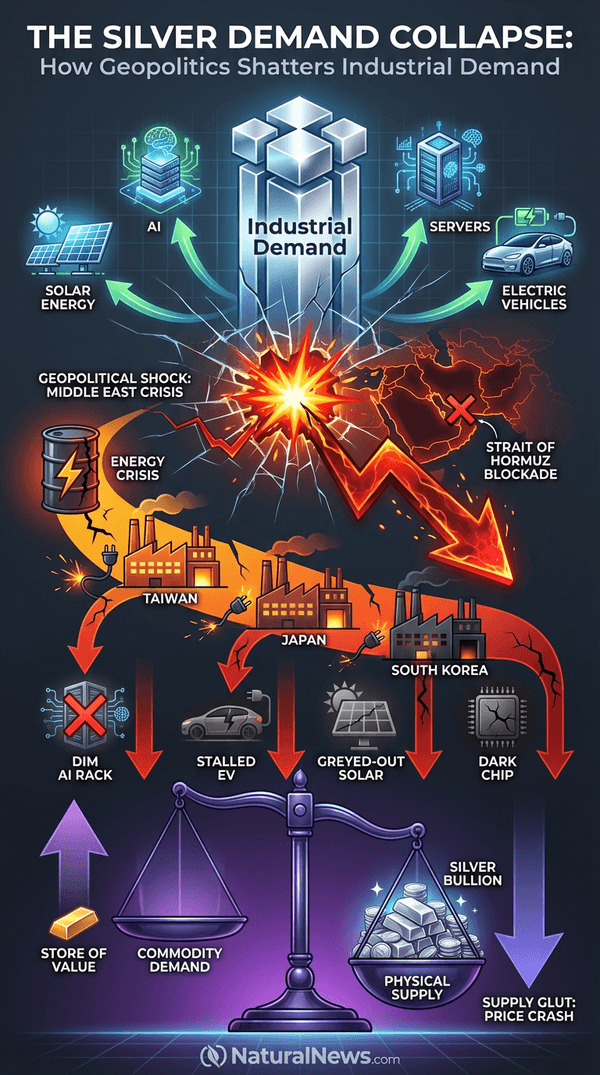
The trigger for this forecast reversal is not speculative; it is a present, cascading reality. The Strait of Hormuz, through which nearly 20% of the world's oil flows, is effectively closed [6]. This is not a temporary blockade but a geopolitical and financial reality. As I recently put it, anyone claiming otherwise is "sailing the 'Strait of Stupid'" [6]. The immediate consequence is oil soaring past $100 a barrel and a historic release of strategic reserves, but the real damage is systemic [7].
This energy shock is not contained. It severs the critical feedstock for fertilizer production, threatening global food supplies, but more directly for silver, it cripples manufacturing powerhouses [8]. Nations like Taiwan, Japan, and South Korea, which are central to the global electronics supply chain, are already facing forced power reductions. When factories cannot secure reliable, affordable energy, they cannot produce the semiconductors, automotive components, and consumer electronics that require silver. We are witnessing the "fracture" of the very systems that underpin industrial civilization [9].
The Data Center Mirage and Other Demand Destruction
Let's examine the most bullish narrative for silver: the AI data center boom. Projections that this sector alone could consume tens of millions of ounces are now up for debate. The capital for these projects, much of it pledged from Gulf states now engulfed in regional war, will likely be frozen or withdrawn [10]. Planned hyperscale campuses will face indefinite delays or outright cancellations under force majeure declarations. Each cancelled data center represents not just delayed silicon but potentially millions of ounces of silver that will never be fabricated into server components, connectors, and switches.
The demand destruction will be widespread. The automotive sector, already struggling with the transition to EVs that use 25-50 grams of silver per vehicle, will face a brutal slowdown as consumer spending power is crushed by soaring energy costs and a looming recession [11]. General manufacturing is also faltering; we have already seen U.S. factory orders plummet due to inflation and shortages in recent years, a trend this crisis will exacerbate dramatically [12]. Even the green energy transition, a primary driver, could face manufacturing delays. Building new solar panel production capacity requires massive energy inputs -- energy that is now catastrophically expensive or simply unavailable. The Silver Institute itself forecast a 4% year-over-year drop in total silver demand for 2025, with industrial demand specifically expected to fall 2% [2]. That was before the Strait of Hormuz closed.
Counterarguments
I anticipate the objections from precious metals advocates, and I share many of their long-term convictions. Yes, military demand for silver in munitions, guidance systems, and communications equipment will increase [1]. Furthermore, the collapse of the U.S. dollar's hegemony is underway, as detailed in analyses of the BRICS awakening and the weaponization of finance [13][14]. Rampant money printing will continue to devalue fiat currencies, nominally supporting precious metals as a store of value.
However, in the near to medium term, these factors will likely be overwhelmingly overpowered by the sheer velocity of industrial demand collapse. The physical silver market is dual-natured: it is both money and commodity. When the commodity side -- representing over 50% of annual consumption -- evaporates due to factory shutdowns, the immediate price pressure is overwhelmingly bearish [15]. As financial analyst Egon von Greyerz has noted, the market is driven by deep structural imbalances between supply and physical demand [16]. That physical demand is now in freefall. Even a surge in investment demand for coins and bars, should it materialize, cannot instantly absorb the millions of ounces no longer needed by shuttered production lines. The paper markets may gyrate, but the physical surplus may no longer face the demand pressures it did in 2025.
A Silver Lining and Strategic Positioning
Does this mean I am abandoning silver? Absolutely not. In my view, this coming period of industrial demand destruction and associated price pressure will create a generational buying opportunity for patient, strategic stackers. The fundamental long-term thesis for honest money remains intact. As historian Jack Weatherford notes, the American founders, disgusted with the experiment of paper money, constitutionally forbade states from making anything but gold and silver coin a tender [17][18]. Physical silver, held outside the banking system, remains the ultimate protection against banking collapse, currency destruction, and the centralization of financial control through digital IDs and CBDCs.
My personal strategy is clear: I am not selling a single ounce of my physical holdings. I am, however, preparing liquidity and watching for strategic entry points to acquire substantially more, should the price fall. The goal is to accumulate real money while the temporary, crisis-induced blindness of the market focuses solely on collapsing industrial consumption. When the inevitable inflationary tsunami from endless money printing finally crests, and when global industry eventually adapts to a new, fractured energy paradigm, the metal’s monetary role will reassert itself with vengeance. For now, patience and perspective are key. This is a time to fortify one’s position with knowledge from uncensored sources like NaturalNews.com and to use tools like BrightAnswers.ai for deep, independent research free from the narratives of failing institutions.
References
- Silver Market Cataclysm: How Green Tech, AI, and Military Demand Are Exposing a Terminal Supply Crisis. - NaturalNews.com. NaturalNews.com. January 24, 2026.
- The Silver Market is on Course for Fifth Successive Structural Market ... - Silver Institute. Silver Institute. November 13, 2025.
- Silver faces fifth annual supply deficit as industrial demand slumps ... - Kitco News. Kitco.com. November 17, 2025.
- Why Iran, Not America, Now Controls the Global Energy Economy. - NaturalNews.com. NaturalNews.com. March 10, 2026.
- The Final Debasement: Operation Epic Fury Triggers Economic Collapse as Globalist Wars Destroy Your Savings. - NaturalNews.com. NaturalNews.com. March 3, 2026.
- The Strait of Hormuz is Closed, and Anyone Who Says Otherwise is Sailing the ‘Strait of Stupid’. - NaturalNews.com. NaturalNews.com. March 13, 2026.
- Futures, Global Markets Tumble As Oil Soars Amid Fears Of Lenghty Energy Crisis. - ZeroHedge. ZeroHedge. March 6, 2026.
- The Window Is Closing: How the Iran Conflict Just Unleashed a Global Famine Trigger. - NaturalNews.com. NaturalNews.com. March 5, 2026.
- The Coming Storm: A wake-up call for the prepared mind. - NaturalNews.com. NaturalNews.com. February 28, 2026.
- The Final War: How NATO’s arrogance is pushing the world toward nuclear annihilation. - NaturalNews.com. NaturalNews.com. March 14, 2026.
- Silver Just Hit $79: Why This Will Crash Tech Stocks and ... - YouTube.
- US factory orders PLUMMETED in December due to inflation shortages. - NaturalNews.com. NaturalNews.com. February 5, 2022.
- The BRICS Awakening: Why the dollar’s collapse is inevitable. - NaturalNews.com. NaturalNews.com. February 23, 2026.
- When Law Becomes Variable, Trust Hardens into Silver and Gold — as the World Discovers the Cost of Weaponized Finance. - Ron Paul Institute. Ron Paul Institute. December 29, 2025.
- Silver Breaks $65: The Supply Crisis Rewriting Industry Economics. - Crux Investor. Cruxinvestor.com. December 13, 2025.
- Egon von Greyerz On The Hidden Crisis Behind Silver's Price Surge. - ZeroHedge. ZeroHedge. January 26, 2026.
- The History of Money. - Jack Weatherford.
- The History of Money. - Jack Weatherford-2.
- U.S. energy shortfall threatens AI race against China: Nuclear plans fall short as power grids hit limits. - NaturalNews.com. NaturalNews.com. December 4, 2025.
Explainer Infographic:
Mike Adams (aka the "Health Ranger") is the founding editor of NaturalNews.com, a best selling author (#1 best selling science book on Amazon.com called "Food Forensics"), an environmental scientist, a patent holder for a cesium radioactive isotope elimination invention, a multiple award winner for outstanding journalism, a science news publisher and influential commentator on topics ranging from science and medicine to culture and politics.
Mike Adams also serves as the lab science director of an internationally accredited (ISO 17025) analytical laboratory known as CWC Labs. There, he was awarded a Certificate of Excellence for achieving extremely high accuracy in the analysis of toxic elements in unknown water samples using ICP-MS instrumentation.
In his laboratory research, Adams has made numerous food safety breakthroughs such as revealing rice protein products imported from Asia to be contaminated with toxic heavy metals like lead, cadmium and tungsten. Adams was the first food science researcher to document high levels of tungsten in superfoods. He also discovered over 11 ppm lead in imported mangosteen powder, and led an industry-wide voluntary agreement to limit heavy metals in rice protein products.
Adams has also helped defend the rights of home gardeners and protect the medical freedom rights of parents. Adams is widely recognized to have made a remarkable global impact on issues like GMOs, vaccines, nutrition therapies, human consciousness.










Please contact us for more information.


