


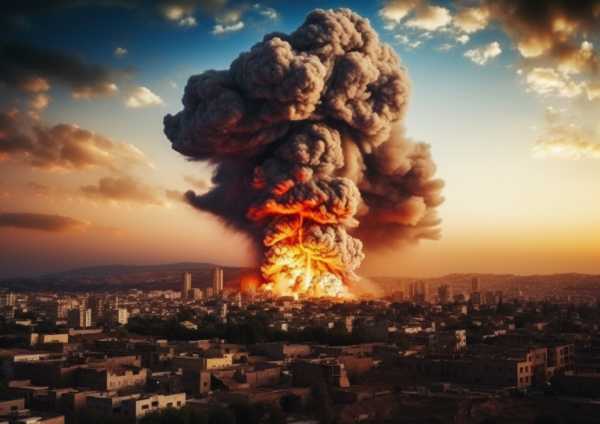
- The U.S. Embassy in Riyadh was struck by two drones, causing damage and forcing staff to shelter in place.
- U.S.-led "Operation Epic Fury" against Iran is intensifying, with stated goals of demilitarizing Iran and eliminating its regime.
- Regional conflict is widening, with Israel expanding strikes into Lebanon and Gulf states like Qatar joining the offensive.
- Critical global oil supplies are being disrupted, with major Iraqi fields shutting down and tanker traffic paralyzed.
- The conflict has resulted in hundreds of casualties, including at least six U.S. service members killed in retaliatory strikes.
In a stark escalation of the burgeoning regional war, the U.S. Embassy in Riyadh, Saudi Arabia, was struck by two drones on Tuesday, March 3, causing a fire and partial roof collapse. The attack, for which Iran is believed responsible, forced embassy personnel to shelter in place and prompted immediate U.S. retaliatory warnings from President Donald Trump. This direct strike on a U.S. diplomatic compound marks a dangerous new phase in the conflict, which began with a massive U.S.-Israeli offensive, dubbed "Operation Epic Fury," over the weekend and is now rapidly spreading across the Middle East, threatening global energy supplies and regional stability.
Operation Epic Fury’s expansive aims
The Pentagon has publicly outlined the operation's sweeping objectives, which extend beyond a punitive raid. The stated goals are the comprehensive demilitarization of Iran—including the destruction of its missile forces, production facilities and naval fleet—the elimination of the current regime, the permanent protection of the United States from Iranian threats, and ensuring Iran cannot possess nuclear weapons. This scale of ambition suggests a campaign far beyond a limited strike, a point underscored by administration officials who now state the operation could last four to five weeks or more, abandoning earlier suggestions of a brief campaign.
Regional war goes multifront
What began as a concentrated assault on Iran has metastasized into a multifront regional conflict. Israel has expanded its operations, conducting a new ground incursion into southern Lebanon and intensifying airstrikes on Beirut. Meanwhile, Gulf states are being drawn directly into the fight. Qatar has formally joined the U.S.-Israeli side, reportedly shooting down Iranian aircraft, and Saudi Arabia and the United Arab Emirates are reportedly considering joining the attack on Iran following sustained drone and missile barrages on their territories. The U.S. has shuttered multiple embassies across the region, including in Beirut, Riyadh and Kuwait, urging Americans to leave.
Energy infrastructure in the crosshairs
The economic stakes of the conflict became dramatically clearer as retaliatory strikes targeted critical energy infrastructure. Iranian drones hit the Port of Salalah in Oman and the key UAE bunkering hub of Fujairah. More consequentially, major disruptions to global oil supplies are now underway. Iraq has been forced to shut down 460,000 barrels per day at the West Qurna 2 field and cut 700,000 barrels per day at the massive Rumaila field. Officials warn that over 3 million barrels per day—roughly 3% of global supply—could be forced offline if tanker traffic through the strategically vital Strait of Hormuz remains paralyzed. Iran’s Revolutionary Guard Corps has declared the strait "closed," though its ability to enforce a blockade is contested.
Mounting casualties and strategic uncertainty
The human cost is climbing on all sides. The reported Iranian death toll since the operation began has risen to at least 787, including the country’s supreme leader. At least six U.S. service members have been killed in retaliatory strikes on bases in Kuwait, and three U.S. F-15 jets were lost in an apparent friendly-fire incident. In Israel, casualties are also mounting from Iranian missile attacks. Despite the overwhelming initial assault, experts caution that the Iranian state and its security apparatus are designed to withstand decapitation strikes, with units prepared to operate autonomously. This structure suggests a capacity for prolonged retaliation, challenging the U.S. assumption that eliminating top leadership would quickly collapse the regime.
A crisis with deep historical roots
The current explosion of violence is the culmination of decades of escalating tensions. For years, the shadow war between Iran and its adversaries—featuring proxy conflicts, targeted assassinations and strikes on oil infrastructure—has inched closer to direct confrontation. The U.S. withdrawal from the 2015 nuclear deal under President Trump, re-imposition of crushing sanctions, and a policy of "maximum pressure" set the stage. Iran’s subsequent acceleration of its nuclear program and expansion of its missile and drone arsenals created what the current administration calls an "intolerable threat." Today’s conflict represents the dangerous failure of diplomacy and deterrence, reviving fears of a major Middle East war not seen since the tanker wars of the 1980s or the initial Gulf War.
Tinderbox
The drone attack on the U.S. Embassy in Riyadh is more than a symbolic provocation; it is a testament to the conflict’s uncontrollable and expanding nature. With diplomatic channels reportedly silent, oil flows choking and military engagements spreading across multiple countries, the war has developed a deadly momentum of its own. The initial goal of neutralizing Iran’s threat has instead unleashed a broader regional conflagration, promising a prolonged period of violence, economic disruption and strategic uncertainty with no clear exit ramp in sight.
Sources for this article include:







Please contact us for more information.


