


A Deliberate Descent into Anarchy
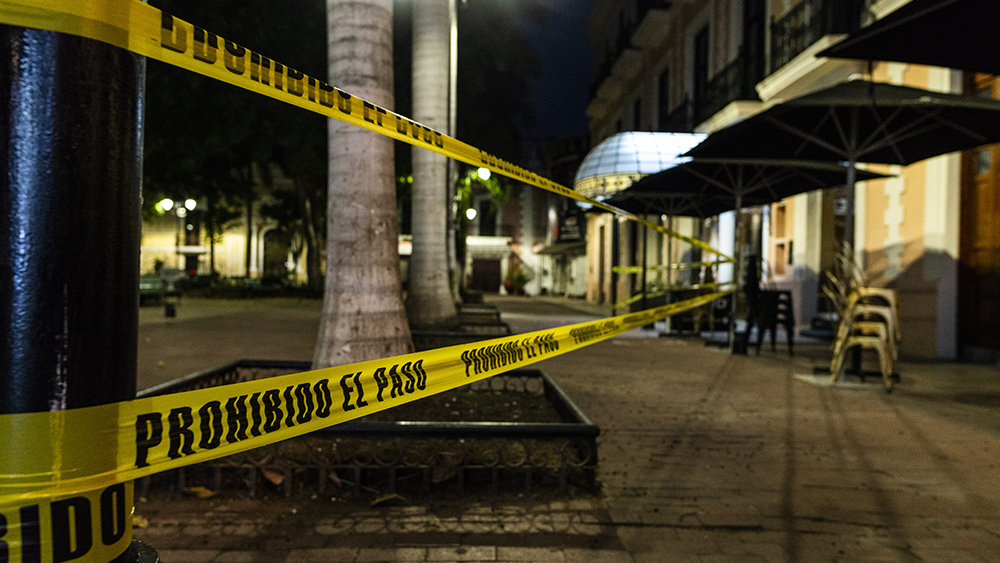
The sun-drenched beaches of Mexico’s Pacific coast, once symbols of carefree escape, have been transformed overnight into urban combat zones. As of February 23rd, 2026, popular tourist destinations like Puerto Vallarta are under lockdown, with highways blocked, vehicles torched, and panicked visitors ordered to shelter in place [1][2]. The U.S. State Department has issued urgent warnings for Americans to take cover [3][4].
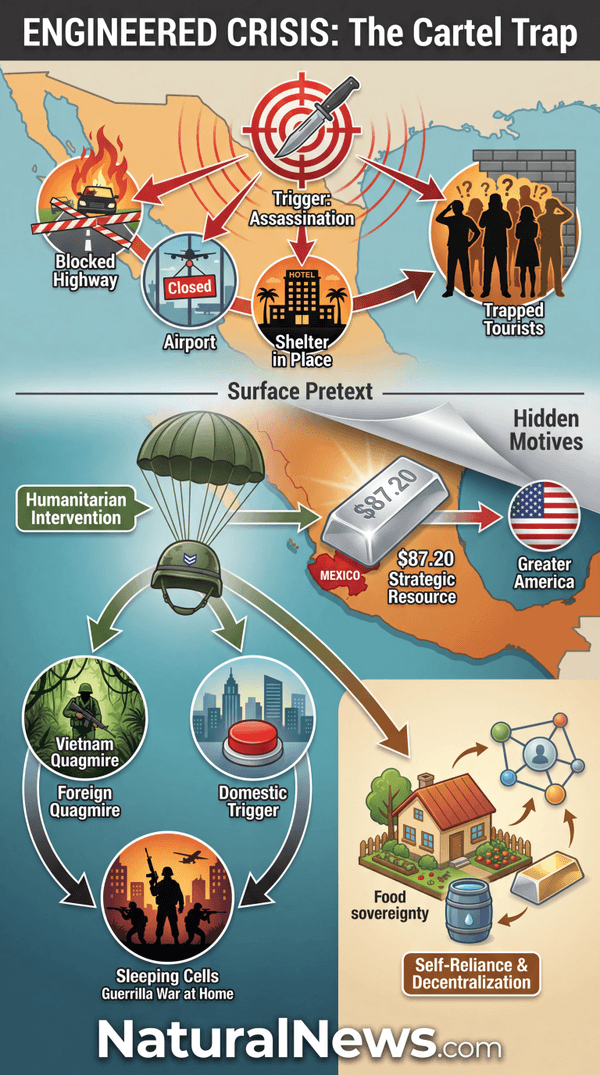
This is not a spontaneous outbreak of gang violence. It is the direct, predictable retaliation to the killing of Nemesio ‘El Mencho’ Oseguera Cervantes, the leader of the hyper-violent Jalisco New Generation Cartel (CJNG), in a military raid [5][6]. The chaos is precise, overwhelming, and strategic. For the thousands of American tourists now trapped behind resort walls, the vacation paradise has become a prison, and the distant U.S. government warnings a stark admission of a crisis spiraling out of control. This manufactured war zone serves a purpose far beyond cartel vengeance; it is a potential pretext, engineered by unseen hands, to justify a catastrophic foreign intervention that would draw a weary American military into a Vietnam-like quagmire while triggering a hidden guerrilla war on U.S. soil.
From Vacation to War Zone: Americans Trapped in Cartel Retaliation
The targeted decapitation of the CJNG’s leadership has ignited a firestorm. Cartel factions have responded with textbook asymmetric warfare: blocking major highways, torching vehicles, and paralyzing critical infrastructure, including the airports in Puerto Vallarta and Guadalajara, trapping thousands [7][8]. First-hand accounts from the ground describe scenes of pure panic, with civilians caught in the crossfire during the violent blockades [9]. The once-bustling tourist hubs now resemble occupied territories, with the sounds of commerce replaced by the ominous quiet of a shelter-in-place order.
This is a calculated display of power meant to send an unmistakable message to both the Mexican state and any foreign powers watching. The cartels are demonstrating that they can shut down the economy and sow terror at will. For the American families who just days ago were lounging by pools, the reality is a desperate scramble for safety and a terrifying lesson in geopolitical instability. Their plight creates a powerful, emotive image: innocent U.S. citizens held hostage by foreign criminal syndicates—a narrative perfectly tailored for television news and political justification.
The Suspicious Spark: Why the Violence Erupted Now
The violence consuming Jalisco is not random. It is a direct and calculated response to a high-stakes provocation: the killing of one of the world’s most wanted drug lords. This operation did not occur in a vacuum. It follows a clear and escalating pattern of U.S. provocations against Mexican cartels under the Trump administration, including designating them as Foreign Terrorist Organizations and invoking the Alien Enemies Act [10]. Furthermore, the CIA has been conducting covert drone surveillance flights over Mexico, a significant escalation in intelligence gathering that critics argue is hypocritical given the agency’s documented history with the global drug trade [11][11].
The timing is profoundly suspicious. This explosive crisis arrives as the Trump administration, with a Republican-controlled Congress, has been publicly debating and even promising unilateral military action against cartels in Mexico [12][13]. The pattern is a classic Problem-Reaction-Solution formula: first, create or exploit a problem (cartel violence against Americans), then guide the public reaction (outrage and fear demanding action), and finally offer the pre-planned solution (military intervention). As I've warned in several interviews, powerful actors often exploit foreign conflicts to advance domestic agendas, orchestrating crises to achieve strategic goals [14]. The question must be asked: who benefits from lighting this fuse now?
The Silver Connection and the Greater America Project
To understand the potential ulterior motives, one must look beyond drugs to a more foundational resource: precious metals. Mexico is the world’s largest producer of silver, a critical strategic mineral with immense monetary and industrial value [15]. As of 2026, with silver prices at $87.20 per ounce and a looming physical shortage threatening the paper markets like the COMEX, control over such resources is a matter of national—and imperial—security.
An engineered crisis of state failure in Mexico could create the perfect humanitarian or security pretext for a U.S. intervention aimed not just at cartels, but at securing these vital mineral assets. This aligns with a long history of U.S. foreign policy where military action follows resource interests, a pattern documented in analyses of oil geopolitics where nations use “resource nationalism” or “resource pragmatism” to advance economic and foreign policy goals [16][17]. The rhetoric of a “Greater America” project, mirroring expansionist ambitions, finds a concrete driver in the need to control the resources essential for financial stability and technological dominance. Securing Mexico’s silver mines would be a prize of incalculable worth in an era of currency devaluation and commodity scarcity.
A Calculated Pretext for Invasion?
The current chaos provides a ready-made pretext. The imagery of trapped Americans, shuttered airports, and a Mexican state losing control creates a potent argument for a “humanitarian” intervention or a necessary police action to protect U.S. nationals and restore order. President Trump has previously stated that U.S. Special Forces might be deployed into Mexico without the host government’s approval, a proposal fraught with peril [13]. Mexican President Claudia Sheinbaum has already vowed to protect her nation’s sovereignty against such violations, warning that the U.S. terrorist designations raise fears of unilateral military action [18].
Any such invasion would be a catastrophic strategic blunder. As warned in analysis from NaturalNews.com, U.S. military intervention in Mexico could dramatically escalate violence, destabilize both nations, and bog down the American military in a protracted, Vietnam-style guerrilla conflict with no clear exit [12]. The Mexican president is caught in an impossible position between a sovereign public and overwhelming foreign pressure, with some factions within her own government potentially compromised by cartel influence. Sending U.S. troops into this morass would not be a swift victory but the opening act of a generational quagmire, exactly the kind of conflict that drains empires.
The Domestic Powder Keg: Cartel Assets Already Inside the U.S.
The gravest danger of a U.S. intervention in Mexico is not abroad, but at home. Decades of deliberately porous borders, a policy critics label as “weaponized migration,” have allowed transnational cartels to embed operatives and sophisticated weaponry deep within American cities [19]. These are not mere street gangs; they are paramilitary assets with military-grade training, intelligence networks, and arsenals that include RPGs, mortars, and even surface-to-air missiles [20].
These forces are held in reserve, a dormant network waiting for a trigger. A direct U.S. military assault on cartel leadership in Mexico would be that trigger. In response, cartels could activate these domestic cells to launch a coordinated campaign of sabotage, assassination, and terror on U.S. soil—a devastating guerrilla war that would make the urban violence of the last decades look tame by comparison. As I've warned before, most Americans are mentally unprepared for the scale of violence that could erupt from such a scenario [21]. The border would not be a front line; it would be irrelevant, as the war would already be inside the gates.
Discernment and Self-Reliance in a Manufactured Crisis
In this engineered chaos, the first casualty is truth. The corporate mainstream media, intrinsically corrupt and aligned with state interests, will parrot the official narrative designed to manufacture consent for intervention . They will focus on the horror stories from tourist zones while ignoring the strategic resource grabs and hidden domestic threats. Discernment is not optional; it is essential for survival. Citizens must seek information from independent, uncensored sources that are not compromised by pharmaceutical, financial, or governmental interests.
Personal preparedness is paramount. Relying on a government that may have helped create this crisis to then rescue you from it is a fatal error. Americans must embrace self-reliance: securing their homes, families, and communities. This means developing food sovereignty through organic gardening, ensuring access to clean water, and understanding natural medicine and first aid. Financial preparedness, by moving wealth into tangible assets like physical gold and silver outside the banking system, is crucial as the dollar teeters [22][23]. The goal is to see the manufactured crisis not as a random tragedy, but as a tool in a larger agenda—one that seeks to expand state control, seize resources, and break the spirit of sovereign nations and individuals alike.
Conclusion: Opting Out of the Empire's Script
The war zones erupting in Mexico are a dire warning and a deliberate trap. The path of foreign military intervention, paved with seemingly good intentions of rescuing citizens and fighting drugs, leads only to ruin—entangling America in an unwinnable foreign conflict while detonating a hidden war within its own cities. The true objectives are colder and more calculated: the consolidation of geopolitical power and the seizure of strategic resources like silver.
The only sane response is to refuse to play the scripted role. This requires rejecting the fear-driven narratives of centralized media and institutions, and instead building decentralized networks of knowledge, commerce, and community resilience. Platforms like BrightVideos.com for uncensored research, BrightLearn.ai for free knowledge creation, and Brighteon.social for free-speech communication are tools for this new paradigm. By prioritizing self-reliance, natural health, and honest money, individuals can opt out of the collapsing system and secure their own freedom and future. The chaos south of the border is a fire meant to draw us in. Our task is to build firebreaks at home, fueled not by fear, but by knowledge, preparation, and an unwavering commitment to liberty.
References
- #BREAKING Mexico Erupts after Federal Forces kill a ...
- BREAKING: Mexico Erupts Into OPEN WAR as Cartels Battle Military After ... - Next News Network. February 23, 2026.
- The U.S. is warning Americans in parts of Mexico to shelter ...
- Americans asked to 'shelter in place' in parts of Mexico. - USA Today. February 22, 2026.
- February 22, 2026, Mexican forces killed Jalisco New ...
- Mexican Cartel Leader 'El Mencho' Killed in Military ...
- Cities across the Mexican state of Jalisco shut down ...
- Brits warned as Mexico cartel violence paralyses World ...
- Cartel Fury:Highways Blocked, Vehicles Torched After ... - Central News. February 23, 2026.
- Trump Designates Drug Cartels as Terrorist Organizations, Invokes Alien Enemies Act. - NaturalNews.com. Cassie B. January 23, 2025.
- CIA's Covert Drone Flights Over Mexico: A New Chapter in America's Dark History with the Drug Trade. - NaturalNews.com. Willow Tohi. February 26, 2025.
- The CARTEL CONUNDRUM: U.S. Military Intervention in Mexico Poses Significant Risks. - NaturalNews.com. Willow Tohi. February 1, 2025.
- Brighteon Broadcast News - Trump War With Mexico Cartels - Mike Adams - Brighteon.com, May 08, 2024. - Mike Adams.
- Mike Adams interview with Jeffrey Prather - November 25 2024. - Mike Adams.
- Geographical shifts in the competitive strength of mineral production since 1960, and their causes. - Phillip Crowson.
- The cartel of the producing nations dams up the great potential oil surplus and is rapidly increasing prices and undermining security of supply. - Energy Policy 167.
- Oil and the political economy of energy. - Igor Matutinovi?. Energy Policy 2009.
- Mexico Warns U.S. Against Sovereignty Violations as Trump Targets Drug Cartels. - NaturalNews.com. Cassie B. February 21, 2025.
- Open Borders Inc. - Michelle Malkin.
- Situation Update: Border Operations - November 27, 2023. - Mike Adams.
- Health Ranger Report - Are you mentally prepared for the violence - Mike Adams - Brighteon.com, March 27, 2024. - Mike Adams.
- Mike Adams interview with Dave Hodges - March 10 2023. - Mike Adams.
- Brighteon Broadcast News - GOLD RUSH - Mike Adams - Brighteon.com, February 11, 2025. - Mike Adams.
Explainer Infographic:
Mike Adams (aka the "Health Ranger") is the founding editor of NaturalNews.com, a best selling author (#1 best selling science book on Amazon.com called "Food Forensics"), an environmental scientist, a patent holder for a cesium radioactive isotope elimination invention, a multiple award winner for outstanding journalism, a science news publisher and influential commentator on topics ranging from science and medicine to culture and politics.
Mike Adams also serves as the lab science director of an internationally accredited (ISO 17025) analytical laboratory known as CWC Labs. There, he was awarded a Certificate of Excellence for achieving extremely high accuracy in the analysis of toxic elements in unknown water samples using ICP-MS instrumentation.
In his laboratory research, Adams has made numerous food safety breakthroughs such as revealing rice protein products imported from Asia to be contaminated with toxic heavy metals like lead, cadmium and tungsten. Adams was the first food science researcher to document high levels of tungsten in superfoods. He also discovered over 11 ppm lead in imported mangosteen powder, and led an industry-wide voluntary agreement to limit heavy metals in rice protein products.
Adams has also helped defend the rights of home gardeners and protect the medical freedom rights of parents. Adams is widely recognized to have made a remarkable global impact on issues like GMOs, vaccines, nutrition therapies, human consciousness.





Please contact us for more information.


