



Introduction: A Future of Decentralization and Deflation
The future isn't arriving incrementally; it's crashing into the present with a series of technological tsunamis. Forget the slow drip of incremental upgrades; we are on the verge of breakthroughs that will shatter centralized control and collapse the cost of living. This isn't about gadgets; it's about a fundamental power shift from corrupt, inefficient institutions to empowered individuals.
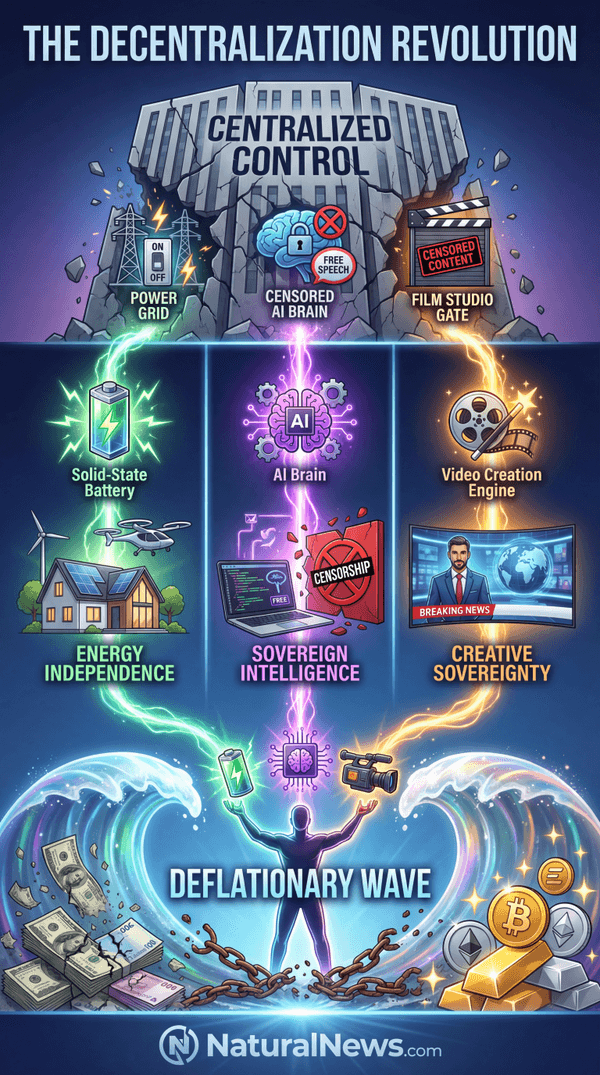
Three imminent technologies—a revolutionary battery, a decentralized AI, and a creative video engine—share a powerful, unifying theme: decentralization. They promise to wrest control over energy, intelligence, and creative expression from centralized gatekeepers like Big Tech, utility monopolies, and Hollywood studios. Their convergence will unleash a powerful deflationary force, drastically slashing costs for power, knowledge, and creation, and placing unimaginable productive power directly into your hands.
Tech 1: The Donut Lab Battery – The End of the Energy Grid as We Know It
Imagine a battery that is lithium-free, charges in five minutes, lasts for 100,000 cycles, and operates flawlessly in extreme heat or cold. This isn't a fantasy; it's the reported promise of advanced solid-state battery technology, the kind that has been suppressed for decades to maintain the dominance of fossil fuels and outdated lithium-ion systems [1]. The implications are staggering. Such a breakthrough would instantly sunset the internal combustion engine, enable practical electric aviation, and make off-grid solar energy storage so cheap and reliable that centralized power grids become optional for millions.
The macro impact would be an economic earthquake. Fossil fuel demand would crash as transportation and energy storage are electrified with superior technology. The grid itself would transform from a fragile, centralized liability into a stabilized network supported by millions of distributed, ultra-resilient storage units in homes and businesses. The cost of transportation—for goods and people—would plummet, delivering a massive deflationary shock across the entire global economy. As one analysis notes, global battery demand is already projected to quadruple by 2030, driven by the transition away from centralized fossil fuel dependence [2]. A leap in battery technology would accelerate this trend beyond all forecasts.
Tech 2: DeepSeek V4 – Decentralized, Uncensored Intelligence at 1/50th the Cost
While America's Big Tech giants push censored, narrative-controlled AI to enforce conformity, a different model is emerging from China: DeepSeek V4. Rumored to be an open-source model utilizing sparse attention architecture, it promises massive cognitive capability at a tiny fraction of the current cost. This isn't just an incremental improvement; it's an economic earthquake that could slash AI API costs by 50 times, enabling fast, local, and completely private agentic AI to run on personal hardware.
The obsolescence event this triggers cannot be overstated. It will render most human programming and countless middle-manager roles economically unnecessary almost overnight. This represents a profound ideological battle: China's push for decentralized, locally-run AI versus the American model of centralized, censored control enforced by corporations like OpenAI and Google [3]. As noted in analysis of the conservative AI illiteracy crisis, ignoring this technological shift is a dangerous gamble, as AI-driven job displacement is already underway [4]. The future belongs to decentralized intelligence platforms like BrightAnswers.ai, which offer uncensored, evidence-based knowledge, bypassing Big Tech's manipulated datasets and putting true cognitive power back in the hands of the individual [3].
Tech 3: SeeDance 2.0 – The Democratization of Hollywood and Education
The final piece of the decentralized future is creative sovereignty. Next-generation prompt-to-video generation tools, evolving beyond today's rudimentary systems, promise consistent characters, scenes, and cinematic styles. This moves far beyond parlor tricks; it decentralizes filmmaking, news production, and education by dismantling the multi-million dollar studio barriers that have kept storytelling captive.
Imagine creating a feature-length educational documentary on holistic health, a series of professional news reports delivered by an AI avatar, or personalized instructional content for any skill—all at a near-zero marginal cost. The competitive landscape shifts from budget size and institutional gatekeeping to the compelling power of human stories and ideas. This technology removes the corrupt middlemen—the studios, the networks, the censors—and allows truth-tellers and educators to communicate directly with global audiences. It is the ultimate tool for bypassing the narrative control of the corporate media, which repeatedly lies and deceives the public to protect establishment interests.
The One Tech That's NOT Ready: Why Home Robots Are Still Sci-Fi
It's crucial to separate imminent reality from deceptive hype. While the three technologies above are at the cusp of commercialization, the promise of sophisticated humanoid robots performing complex, safe tasks in unstructured home environments is still years away from viability. The realistic path for robotics begins in controlled industrial and agricultural settings, not in your living room [5].
We must maintain extreme skepticism towards companies and governments promising imminent consumer robot deliveries for tackling home tasks like washing the laundry or loading automatic dishwasher machines. This hype often serves a darker depopulation agenda, where globalists seek to replace humans with AI robots [6]. The future of empowerment is not about being served by robots; it's about wielding the tools of creation, energy, and intelligence yourself. The centralized push for humanoid servitude is a distraction from the real, decentralized empowerment happening now.
Conclusion: Living in a Decentralized Future – Next Week
These three technologies—ultra-cheap energy independence, sovereign uncensored intelligence, and limitless creative power—converge into a single, unstoppable force: individual empowerment. They herald a deflationary tsunami that will collapse the costs of goods, services, and information creation, breaking the debt-based fiat system propped up by corrupt central banks [7].
This is a call to action: embrace and master the tools for decentralized living. Move your savings into honest money like gold and silver and explore decentralized cryptocurrencies. Use uncensored platforms like Brighteon.social, BrightAnswers.ai, and BrightLearn.ai to access and share knowledge freely. The future isn't about waiting for a savior or a robot butler. It's about claiming the unimaginable creative and productive power that is finally being unlocked, moving power decisively from corrupt, centralized institutions to the sovereign individual where it always belonged.
References
- The Arcane Anode: Forbidden Lore and Esoteric Secrets of Solid State Batteries.
- Global battery demand expected to QUADRUPLE by 2030. - NaturalNews.com.
- Decentralized AI vs. Centralized Control: The fight for information freedom. - NaturalNews.com.
- The Conservative AI Illiteracy Crisis: Unpacking the Blind Spots. - NaturalNews.com.
- Laser Herders: The LIDAR-Guided Revolution of Robotic Worm Swarms.
- The Clawdbot Catastrophe: How AI Hype Unleashed a Digital Apocalypse in Weeks. - NaturalNews.com.
- "Modern Money Only Works By Cheating": If You're Long Bitcoin (Or Not Long Bitcoin), Read This... - ZeroHedge.
Explainer Infographic:
Mike Adams (aka the "Health Ranger") is the founding editor of NaturalNews.com, a best selling author (#1 best selling science book on Amazon.com called "Food Forensics"), an environmental scientist, a patent holder for a cesium radioactive isotope elimination invention, a multiple award winner for outstanding journalism, a science news publisher and influential commentator on topics ranging from science and medicine to culture and politics.
Mike Adams also serves as the lab science director of an internationally accredited (ISO 17025) analytical laboratory known as CWC Labs. There, he was awarded a Certificate of Excellence for achieving extremely high accuracy in the analysis of toxic elements in unknown water samples using ICP-MS instrumentation.
In his laboratory research, Adams has made numerous food safety breakthroughs such as revealing rice protein products imported from Asia to be contaminated with toxic heavy metals like lead, cadmium and tungsten. Adams was the first food science researcher to document high levels of tungsten in superfoods. He also discovered over 11 ppm lead in imported mangosteen powder, and led an industry-wide voluntary agreement to limit heavy metals in rice protein products.
Adams has also helped defend the rights of home gardeners and protect the medical freedom rights of parents. Adams is widely recognized to have made a remarkable global impact on issues like GMOs, vaccines, nutrition therapies, human consciousness.








Please contact us for more information.


