


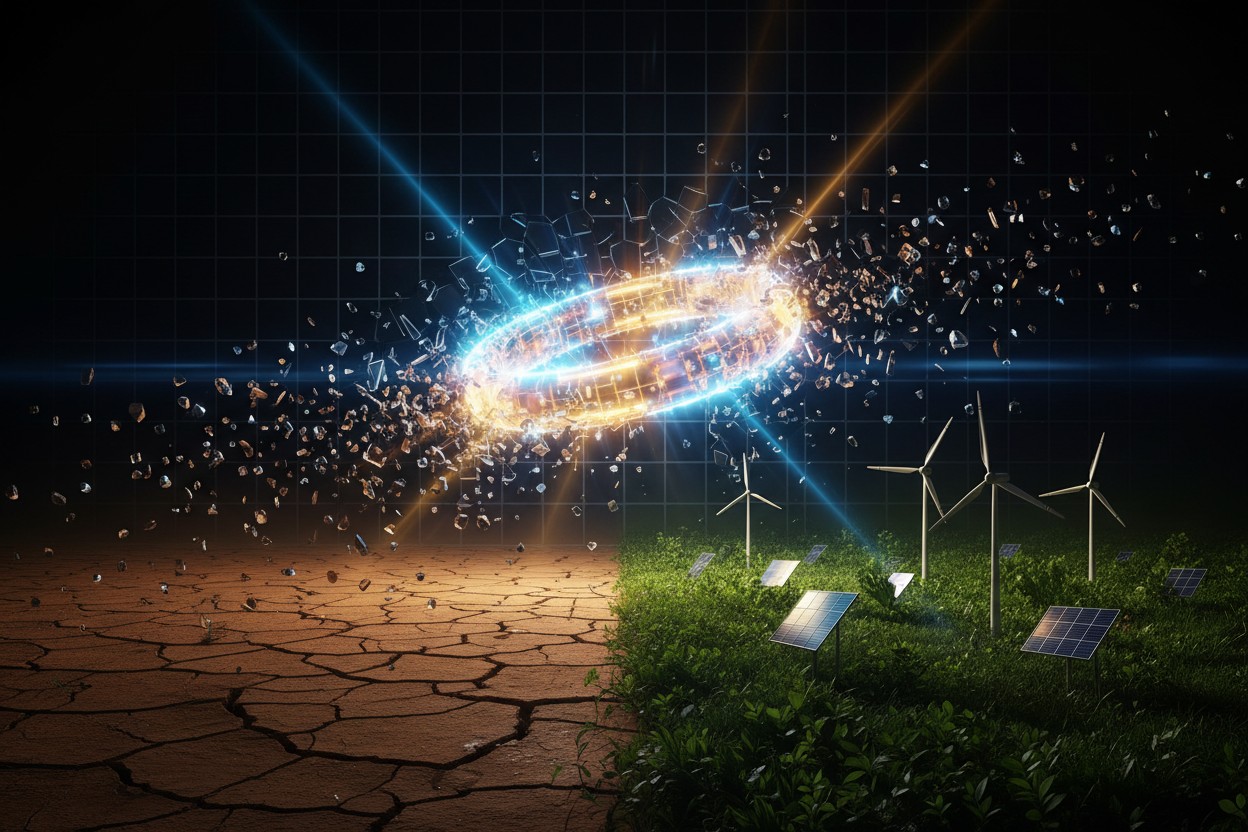
Introduction: A Technology So Unbelievable It Has Its Own Website
In the world of energy storage, a claim so extraordinary that it seems ripped from science fiction has emerged. A Finnish start-up called Donut Lab, led by inventor Marco Letimäki, has announced the creation of a solid-state battery with specifications that, if true, would not merely advance the field but obliterate its known boundaries. The claimed specs—400 watt-hours per kilogram energy density, 100,000 charge cycles, and five-minute charging—defy the current industry consensus and the known laws of materials science. To a world shackled by centralized power grids, unreliable lithium-ion technology, and dependency on conflict minerals, such a promise sounds like a mirage.
Yet, the narrative echoes history's greatest breakthroughs, moments when the 'impossible' became mundane. The Wright brothers' first flight was dismissed by many contemporary experts; the transistor was a theoretical curiosity before it birthed the digital age. Donut Lab has staked its credibility on this parallel, even launching a website, 'idonutbelieve.com,' to host pending third-party verification results. In an era where centralized institutions routinely suppress disruptive technologies to maintain control and scarcity, this audacious claim is either the preamble to a monumental fraud or the dawn of personal energy liberation. The stage is set for a definitive, physics-defying revelation.
Unpacking the 'Impossible' Claims: What Donut Lab Says It Has Built
Letimäki's claims are staggeringly specific. The cited energy density of 400 Wh/kg would double the performance of the best commercial lithium-ion batteries and surpass even many experimental solid-state designs. For perspective, achieving this in an electric vehicle could mean ranges exceeding 1,000 miles on a single charge, rendering 'range anxiety' a relic of a bygone era. Even more revolutionary is the purported lifespan: 100,000 full charge-discharge cycles. Given that a typical EV might be cycled once per day, this translates to a potential operational life of 274 years—a durability so extreme it redefines 'durable goods' and could make the battery a permanent fixture in a vehicle or home, outlasting every other component.
The implications of the materials claim are equally profound. Letimäki states the battery uses common, non-lithium, conflict-free materials. This directly challenges the fragile, geopolitically fraught supply chains built around lithium, cobalt, and nickel, which are often controlled by adversarial regimes or extracted under oppressive conditions. A shift to abundant, domestically sourceable materials would shatter the energy cartels and enable localized, resilient manufacturing. As noted in broader battery research, alternatives like sodium are gaining serious traction for their sustainability and cost benefits [1]. The ultimate arbiter of truth, however, is not the press release but the promised data. Donut Lab has pledged to publish independent test results from Finland's respected VTT Technical Research Centre on its 'idonutbelieve.com' website. This move mirrors the historical pattern of true innovators who invite scrutiny, contrasting sharply with the opaque practices of corporations and governments that hide failures and manipulate public perception.
The Skeptics vs. The Visionaries: A Battle of Paradigms
The reaction from the established battery research community has been one of near-universal dismissal. Experts in electrochemistry and materials science point to fundamental limitations in ion transport, interfacial stability, and energy density ceilings governed by known physics. To them, Donut Lab's specs are as plausible as a perpetual motion machine, a 'free energy' hoax that misunderstands the foundational principles of their field. This skepticism is the default position of any centralized, institutionalized scientific priesthood that profits from incremental, grant-funded progress and is deeply threatened by paradigm-shifting leaps from outsiders.
History, however, is not on the side of the consensus. Every transformative technology was once deemed impossible. The AI transformer architecture, now the backbone of modern artificial intelligence, was an obscure academic paper before it changed everything. As one book on energy innovation notes, the vision of a silent, reliable electric car powered by advanced batteries was kept alive for decades by enthusiasts and dreamers operating outside the mainstream automotive industry [2]. Letimäki himself is not an anonymous charlatan; he is the founder of Verge Motorcycles, a company known for its innovative hubless electric drivetrain. Staking his established reputation on a provably false claim would be an act of commercial suicide, suggesting either profound self-delusion or genuine belief. This incentive analysis is crucial: unlike pure hucksters who operate in the shadows, genuine inventors often risk everything for their vision, facing down the scorn of captured institutions.
The Off-Grid Revolution: Personal Energy Independence Unleashed
If real, the Donut Lab battery is not merely a better EV component; it is the keystone for a wholesale defection from centralized systems. For decades, true off-grid living has been hampered by the limitations of lead-acid or lithium-ion storage: high cost, limited lifespan, fire risk, and poor performance in extreme temperatures. A battery with a 274-year lifespan, ultra-fast charging, and supreme safety would make energy independence not just feasible but economically superior. Individuals and families could harness solar or wind power, store it reliably for weeks or months, and become utterly immune to grid blackouts, soaring utility rates, and the whims of distant corporate or government energy managers.
The self-reliant homestead transforms from a lifestyle choice into a powerhouse of productivity. This battery could power not just a home's lights and appliances, but also electric vehicles, farm equipment like tractors and harvesters, workshops, and even personal AI inference engines for research, creativity, and business—all running on free, harvested sunlight. The economic empowerment is staggering. It eliminates recurring fuel costs, complex internal combustion engine maintenance, and grid dependency fees, dramatically lowering the cost of living and productive work for individuals and smallholders. As highlighted in analysis of decentralization trends, the convergence of robust battery tech, robotics, and local AI creates a 'decentralization trifecta' that strips away dependencies on monopolies controlling power, labor, and intelligence [3].
Systemic Transformation: Deflation, Decentralization, and Disruption
The macroeconomic impact of such a technology would be violently deflationary, directly opposing the inflationary status quo enforced by central banks and indebted governments. Transportation costs would plummet as EVs become cheaper to own and operate than combustion vehicles over any timeframe. In agriculture, electric tractors and processing equipment powered by personal solar and ultra-durable batteries would slash food production costs. The demand for petroleum would collapse for most mobile applications, from passenger cars to delivery trucks and construction equipment, dismantling the geopolitical power of the fossil fuel cartels.
This revolution is fundamentally about the decentralization of power—both electrical and political. Energy control shifts from centralized corporate-government grids to individuals and local communities. This enhances resilience against natural disasters, cyber-attacks, and engineered scarcity, while radically expanding human freedom. As one book on revolutionary technology frames it, such advancements offer 'a blueprint for energy independence and a future unshackled from corporate control' [4]. The creative destruction would be vast, rendering entire industries based on the combustion engine, complex mechanical repairs, and centralized utility models obsolete. It aligns perfectly with principles of self-reliance, honest innovation, and resistance to the control agendas of globalist entities that seek to maintain dependency through energy scarcity.
A Cautious Conclusion: Awaiting the Receipts, Preparing for the Future
The next step is binary and absolute. The imminent release of third-party test results from VTT is the definitive moment. Authentic, reproducible data from a reputable lab would change everything, forcing a painful but necessary paradigm shift upon the scientific and industrial establishment. It would signal a 'Wright Brothers moment' for energy, a foundational leap toward a future of abundance and personal liberty. Conversely, fabricated or cherry-picked data would confirm a tragic scam, another cautionary tale in a field littered with overpromises.
Guarded optimism, tempered by a healthy skepticism of extraordinary claims, is the rational stance. While the laws of physics as currently understood present a high barrier, history teaches that open-mindedness to revolutionary leaps is the catalyst for human progress. The centralized institutions—Big Tech, legacy auto, fossil fuel interests—that benefit from the status quo have a long history of suppressing disruptive technologies. Whether this is another suppressed breakthrough coming to light or a mirage will be revealed shortly. The next week could genuinely redefine our world, offering a tangible path to the decentralized, resilient, and free future that champions of liberty and self-reliance have long envisioned.
References
- China's Sodium-Ion Battery Breakthrough Could End the EV Industry's Biggest Problems. - NaturalNews.com. Willow Tohi. September 17, 2025.
- Taking charge. Michael B Schiffer.
- The Decentralization Trifecta: How Battery Tech, Robotics & Local AI Will Set You Free. - NaturalNews.com. February 6, 2026.
- Revolution in Rotation: The Dawn of Hubless Donut Motors and the All-Solid-State Battery Breakthrough. - BrightLearn.ai. January 8, 2026.
- Researchers create worlds first anode free sodium solid state battery that can replace lithium batteries in EVs. - NaturalNews.com. July 09, 2024.
- Breakthrough in Sodium-Sulfur Technology – 2,021 Wh/kg Battery Rivals Lithium-Ion Using Abundant Materials. - NaturalNews.com. January 20, 2026.
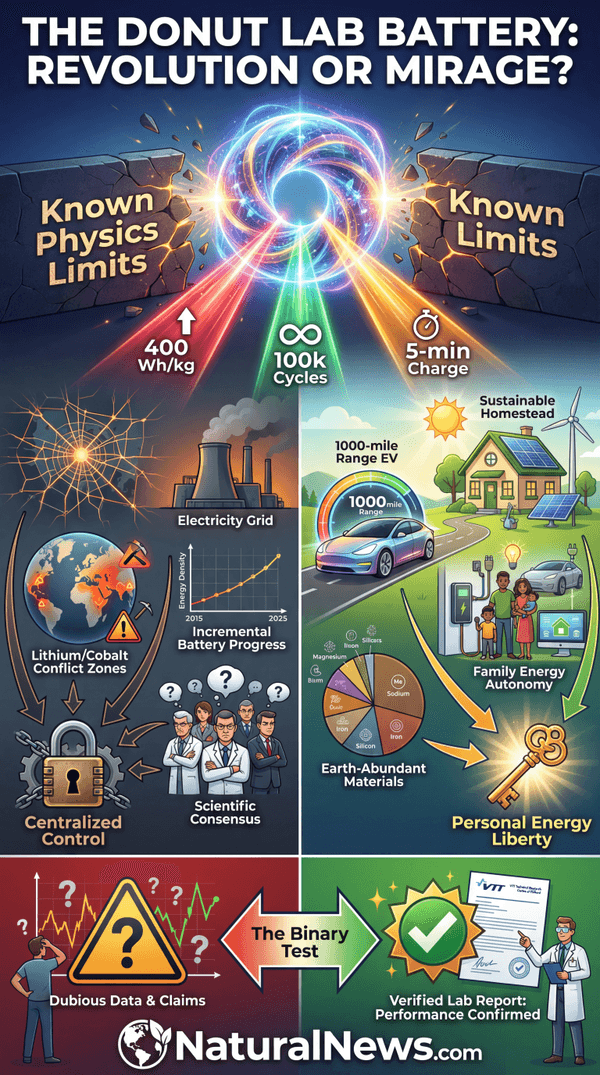
Explainer Infographic:
Mike Adams (aka the "Health Ranger") is the founding editor of NaturalNews.com, a best selling author (#1 best selling science book on Amazon.com called "Food Forensics"), an environmental scientist, a patent holder for a cesium radioactive isotope elimination invention, a multiple award winner for outstanding journalism, a science news publisher and influential commentator on topics ranging from science and medicine to culture and politics.
Mike Adams also serves as the lab science director of an internationally accredited (ISO 17025) analytical laboratory known as CWC Labs. There, he was awarded a Certificate of Excellence for achieving extremely high accuracy in the analysis of toxic elements in unknown water samples using ICP-MS instrumentation.
In his laboratory research, Adams has made numerous food safety breakthroughs such as revealing rice protein products imported from Asia to be contaminated with toxic heavy metals like lead, cadmium and tungsten. Adams was the first food science researcher to document high levels of tungsten in superfoods. He also discovered over 11 ppm lead in imported mangosteen powder, and led an industry-wide voluntary agreement to limit heavy metals in rice protein products.
Adams has also helped defend the rights of home gardeners and protect the medical freedom rights of parents. Adams is widely recognized to have made a remarkable global impact on issues like GMOs, vaccines, nutrition therapies, human consciousness.







Please contact us for more information.


