


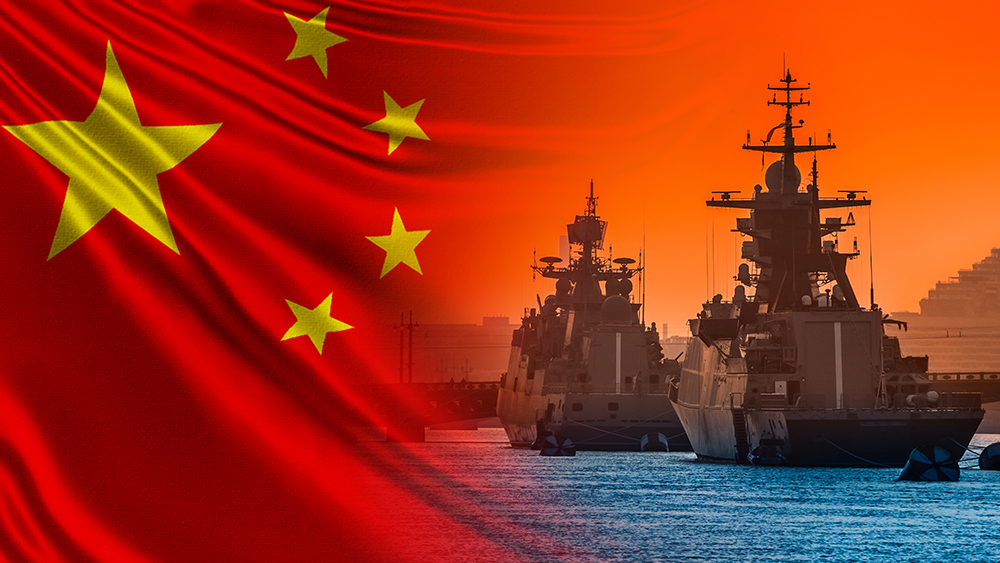
- China has secretly stockpiled 1.1 to 1.2 billion barrels of crude oil, which is enough to fuel its economy and military for three months without imports.
- Beijing’s massive oil reserves are a strategic war preparation, ensuring its military can operate even under a U.S. blockade during a Taiwan conflict.
- Satellite data and trade records reveal China has added 400 million barrels of oil in each of the past two years, mirroring pre-WWII military stockpiling tactics.
- The Pentagon warns China’s military will be ready for a full-scale Taiwan invasion by 2027, with oil reserves ensuring its war machine won’t stop under sanctions or blockade.
- Taiwan produces 60% of the world’s semiconductors, and China’s control of the island would cripple global supply chains, U.S. military tech, and consumer electronics overnight.
China is quietly amassing a war chest of crude oil—enough to fuel its economy and military for months without a single import. New data reveals Beijing has stockpiled an estimated 1.1 to 1.2 billion barrels, with analysts warning this isn’t just about energy security; it’s about preparing for war. The question isn’t if China is getting ready for conflict, but when it will strike.
For years, China has been hoarding commodities at an unprecedented scale, with 80% of global copper, 70% of corn, 51% of wheat, and now more than 400 million barrels of oil in just the past two years alone. But oil is different. Unlike food or metals, oil is the lifeblood of modern warfare, powering tanks, jets, and naval fleets. And China, which imports more than 70% of its crude through sea lanes patrolled by the U.S. Navy, knows its supply lines are vulnerable. If war breaks out over Taiwan, those routes could be cut off in days. Beijing’s solution? A three-month buffer, which is enough to keep its economy and military running even if the U.S. imposes a blockade.
A hidden arsenal: Why China’s oil reserves spell danger
China doesn’t just stockpile oil; it hides it. The government treats inventory levels as a state secret, refusing to disclose how much is stored or where. Satellite imagery and trade data suggest Beijing has been filling its reserves at a breakneck pace, adding 400 million barrels in both 2024 and 2025. That’s not just a rainy-day fund; it’s a war reserve.
Historically, nations stockpile oil before major conflicts. Before World War II, Britain and the U.S. built strategic reserves to ensure their militaries wouldn’t run dry. China is doing the same, but on a scale never seen before. Analysts testifying before the U.S.-China Economic and Security Review Commission warned that this buildup is a "strategic warning indicator" that Beijing is preparing for a showdown with the U.S. over Taiwan.
The Pentagon’s latest report confirms the worst: China’s military is on track to be ready for a full-scale invasion of Taiwan by 2027. President Xi Jinping has publicly vowed to "reunify" the island, by force if necessary. With hypersonic missiles, cyber warfare units, and a rapidly expanding navy, China is no longer just a regional threat; it’s a global one. And its oil reserves ensure that even under sanctions or blockade, its war machine won’t stop.
The Taiwan countdown: Why 2027 is the red line
The Pentagon has long warned that 2027 is China’s target date for a Taiwan invasion. That’s when Beijing expects its military to be strong enough to overwhelm U.S. defenses in the Pacific. But oil is the missing piece of the puzzle. Without secure fuel supplies, China’s warships, fighter jets, and armored divisions would grind to a halt within weeks. By stockpiling three months’ worth of imports, Beijing is ensuring it can fight – and win – a prolonged conflict.
The stakes are high. Taiwan isn't just a territorial dispute; it's the semiconductor capital of the world, producing over 60% of global chip output and approximately 90% of the world's most advanced chips. If China seizes the island, it would reshape the global economy overnight. And with China’s military now capable of striking 1,500 to 2,000 nautical miles from its shores, U.S. bases in Guam, Japan, and the Philippines are within range.
The U.S. is running out of time
America’s response? Sanctions, saber-rattling, and hope. The U.S. has attempted to restrict China's access to advanced chips through export controls, but the effort has been inconsistent — with the Trump administration both tightening and loosening restrictions — while China has partially offset the impact through domestic innovation and smuggling, though it still lags in the most advanced chip manufacturing.
Meanwhile, the U.S. Navy, which was once the undisputed ruler of the seas, is struggling to keep up. China’s shipbuilding capacity is 200 times larger than America’s, and its navy is now the world’s largest. If war breaks out, the U.S. may not be able to protect Taiwan’s supply lines... or its own.
If Beijing cuts off rare earth exports, crashes the dollar, or weaponizes its oil reserves, the U.S. could face hyperinflation, fuel shortages, and a stock market collapse, all while fighting a war it might not win.
The oil stockpiles, the military drills, the cyberattacks on U.S. infrastructure... all of it points to one conclusion: Beijing believes it can win.
Sources for this article include:







Please contact us for more information.


