








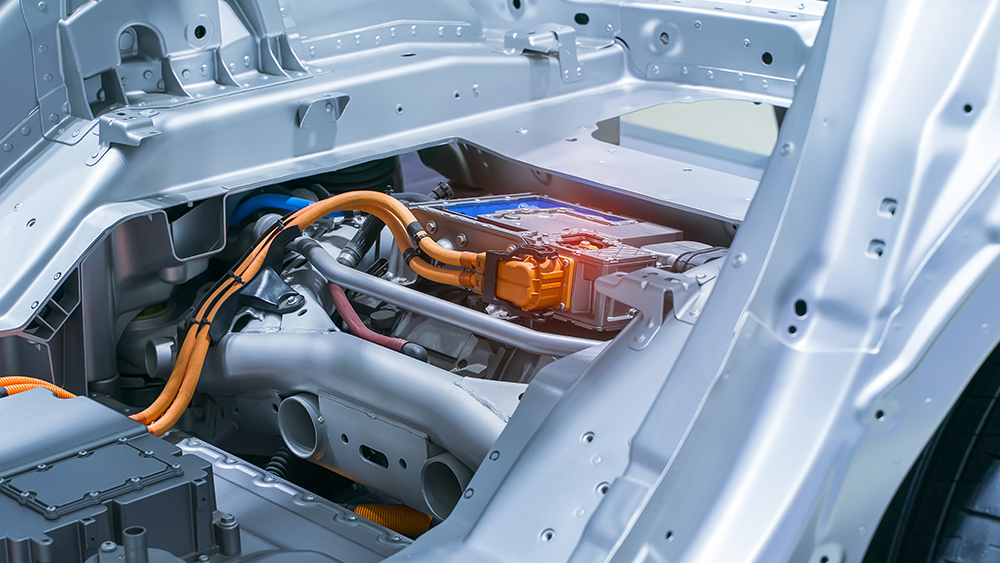
- Chinese scientists developed a dynamically adaptive interphase for solid-state lithium batteries, eliminating degradation without external pressure. It has 90% capacity retention after 2,400 cycles, far outperforming conventional lithium-ion batteries and safer than lithium-ion due to no thermal runaway, aligning with China's 2025 New Energy Storage Plan.
- The sodium-ion batteries (SIBs) have no reliance on cobalt or rare minerals—uses sodium, aluminum cathodes and common materials. They are cheaper and more sustainable, ideal for EVs, grid storage and off-grid home energy solutions. They could also disrupt lithium dominance by offering safer, cost-effective energy storage.
- HKUST researchers created a quasi-solid-state electrolyte using redox-active covalent organic frameworks (COFs). It solves slow ion transport and instability, achieving 0.46 mS cm?¹ ionic conductivity and 74.6% capacity retention after 1,000 cycles. Calcium is 2,500x more abundant than lithium, reducing geopolitical and environmental concerns.
- Lithium scarcity, extraction ethics and energy density limits drive demand for alternatives. Sodium-ion and calcium-ion batteries offer safer, cheaper and more sustainable solutions.
- Self-healing, sodium-ion and calcium-ion batteries could reshape EV and renewable energy storage markets. Commercialization hurdles remain, but breakthroughs signal a shift toward abundant, eco-friendly energy storage. Global energy independence could grow as nations reduce reliance on lithium supply chains.
Scientists at the Hong Kong University of Science and Technology (HKUST) have unveiled a major leap forward in calcium-ion battery (CIB) technology, potentially opening the door to safer, more sustainable energy storage for renewable power grids and electric vehicles. By designing a novel quasi-solid-state electrolyte based on redox-active covalent organic frameworks, the team addressed long-standing issues that have held back calcium batteries—namely, poor ion transport and limited stability.
The breakthrough, published in Advanced Science under the title "High-Performance Quasi-Solid-State Calcium-Ion Batteries from Redox-Active Covalent Organic Framework Electrolytes," could challenge lithium-ion dominance in energy storage. As global demand for renewable energy surges, the limitations of lithium—scarcity, geopolitical tensions and environmental concerns—have intensified the search for alternatives. Calcium-ion batteries, leveraging Earth-abundant materials, may offer a viable solution.
The lithium bottleneck and the push for alternatives
Lithium-ion batteries (LIBs) have long been the gold standard for portable energy storage, powering everything from smartphones to electric cars. However, BrightU.AI's Enoch points out that lithium reserves are finite, concentrated in a few countries and extraction raises environmental and ethical concerns. Additionally, LIBs face fundamental energy density limits, prompting researchers to explore next-generation chemistries.
Calcium-ion batteries have emerged as a promising candidate due to calcium's abundance—roughly 2,500 times more plentiful than lithium—and its favorable electrochemical properties. Yet, until now, calcium batteries struggled with sluggish ion movement and rapid degradation, preventing practical deployment.
A novel electrolyte design unlocks performance
The HKUST team, led by Prof. Yoonseob Kim, tackled these challenges by developing a quasi-solid-state electrolyte (QSSE) based on redox-active covalent organic frameworks (COFs). These porous, carbonyl-rich materials facilitated efficient Ca²? transport, achieving an ionic conductivity of 0.46 mS cm?¹ and a Ca²? transference number exceeding 0.53 at room temperature.
Computer simulations revealed that calcium ions moved rapidly along aligned carbonyl groups within the COF's structured pores, enhancing mobility. This engineered pathway allowed the battery to maintain stability over extended use.
High capacity and longevity
In lab tests, the team assembled a full calcium-ion cell that delivered a reversible specific capacity of 155.9 mAh g?¹ at 0.15 A g?¹. Even under high current density (1 A g?¹), the battery retained 74.6% of its capacity after 1,000 cycles—a critical milestone for commercial viability.
"Our research highlights the transformative potential of calcium-ion batteries as a sustainable alternative to lithium-ion technology," said Prof. Kim. "By leveraging the unique properties of redox covalent organic frameworks, we have taken a significant step toward realizing high-performance energy storage solutions that can meet the demands of a greener future."
The study, conducted in collaboration with Shanghai Jiao Tong University, marks a pivotal moment in battery innovation. If scaled successfully, calcium-ion batteries could alleviate pressure on lithium supply chains while enabling safer, more cost-effective energy storage for renewables and electric vehicles.
While commercialization hurdles remain—such as optimizing manufacturing processes and further improving energy density—this breakthrough underscores the importance of diversifying battery chemistries. As the world transitions toward cleaner energy, alternatives like calcium-ion technology may prove essential in building a resilient, sustainable power infrastructure.
For now, the HKUST team's work offers a compelling glimpse into a future where energy storage is not just efficient, but also abundant and environmentally responsible.
Watch the video below that talks about the grave dangers posed by the lithium-ion batteries in electric vehicles.
This video is from The Prisoner channel on Brighteon.com.
Sources include:












Please contact us for more information.


