


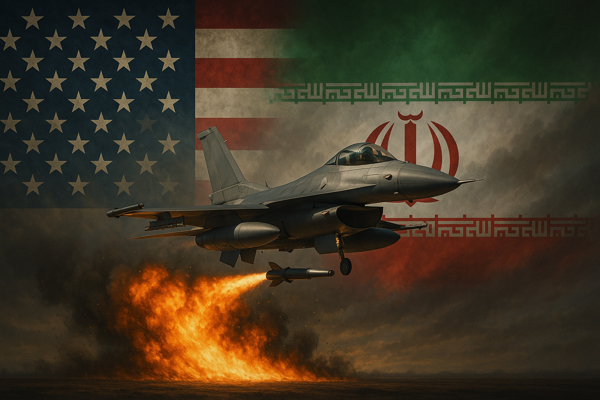
- Iran has denied major damage to its nuclear sites. Iranian officials and state media have also claimed that U.S. airstrikes caused only superficial damage to facilities like Fordow and Natanz, with no radiation leaks or major setbacks. They accused Trump of exaggerating the impact.
- The U.S. launched a massive but possibly ineffective strike. Operation Midnight Hammer involved 125 aircraft and bunker-buster bombs, but Iran claimed it moved uranium and evacuated personnel beforehand, minimizing damage.
- Iran retaliated with a measured missile strike. Tehran attacked a U.S. base in Qatar but gave warnings to avoid casualties, signaling restraint. Trump dismissed the attack as "weak," while Iran warned of further responses if provoked.
- Israel escalated by targeting Iran's leadership. Beyond military sites, Israel bombed Evin Prison, which was holding political prisoners, and IRGC posts, aiming to weaken Iran's regime amid leadership uncertainty.
- Both sides are avoiding full-scale war for now, but tensions run high. Iran faces economic strain, while the U.S. and Israel push further, risking prolonged confrontation. The U.S. strike didn't cripple Iran's nuclear program as claimed, and Iran's cautious retaliation suggests neither side wants full war. The situation remains unstable, with further clashes likely.
Iranian state media has sharply rejected President Donald Trump's claims that American airstrikes "completely and totally obliterated" Tehran's nuclear facilities, insisting that damage from the attack was minimal and easily repairable.
Meanwhile, tensions continue to escalate as Iran launches retaliatory missile strikes on a U.S. base in Qatar and threatens further action.
Nuclear facilities "superficially" damaged, Iran claims
Following Operation Midnight Hammer, the codename for a massive airstrike involving 125 aircraft and precision-guided bunker-buster bombs, Trump boasted that Iran's Fordow, Natanz and Esfahan nuclear sites had been wiped out.
However, Iranian officials and state-run media have dismissed these claims as exaggerated, if not outright false.
Mohammad Manan Raisi, a lawmaker from Qom Province where Fordow is located, told the Fars News Agency that the damage was "superficial" and that it was limited to ground-level structures with no casualties or radiation leaks. Raisi also accused Trump of lying, stating that the facility remained largely intact and could be quickly restored.
Iranian authorities had reportedly evacuated personnel and moved enriched uranium to undisclosed locations before the attack, according to Hasan Abedini of the state-run Iranian Broadcasting Corporation.
Meanwhile, Deputy Health Minister Alireza Raisi also denied any risk of radioactive contamination, reinforcing Tehran's narrative that the strikes were ineffective.
The International Atomic Energy Agency (IAEA) confirmed no spike in radiation levels, further undermining Trump's assertions.
Operation Midnight Hammer: A show of force with limited impact?
The U.S. military detailed an elaborate operation on June 22 involving B-2 stealth bombers, decoy jets and submarine-launched cruise missiles.
General Dan Caine, chairman of the Joint Chiefs of Staff, described an 18-hour flight path designed to evade detection before striking the three nuclear sites in Iran.
But if Iranian reports are accurate, Operation Midnight Hammer failed to achieve its primary objective: crippling Iran's nuclear program. Instead, it may have strengthened Tehran’s resolve.
The Islamic Revolutionary Guard Corps (IRGC) condemned the strikes as illegal and vowed retaliation, warning that the U.S. and Israel would face "heavy responses."
Iran strikes back, but carefully
True to its word, Iran launched missiles at Al Udeid Air Base in Qatar, a key U.S. military hub. However, the attack appeared calculated to avoid escalation, and advance warnings ensured no casualties. Damage was also minimal.
Trump dismissed it as a "very weak response," suggesting Iran was unwilling to risk all-out war.
Still, Iranian Foreign Minister Abbas Araqchi warned that further U.S. actions would be met with additional retaliation. The strike strained relations with Gulf neighbors, with Qatar, Saudi Arabia and others condemning Tehran's aggression.
Israel targets Iran's regime
Meanwhile, Israel expanded its bombing campaign beyond military and nuclear sites, striking Evin Prison, a notorious detention center for political dissidents, and Revolutionary Guard command posts.
The move signaled a shift toward undermining Iran's ruling apparatus, not just its military capabilities. (Related: Iran rules out diplomacy amid Israeli attacks.)
With Tehran's leadership reportedly discussing succession plans for Supreme Leader Ayatollah Ali Khamenei, the pressure is mounting.
However, Iran's options are limited. Its economy is already battered, and further escalation risks alienating even its few remaining allies, like Russia.
For now, both sides seem to be testing boundaries without plunging into full-scale war. Trump has framed Iran’s restrained retaliation as a sign of weakness, while Tehran insists it retains the upper hand.
But with Israel continuing its bombardment and Iran threatening further strikes, the conflict remains dangerously volatile.
One thing is clear: Trump's claim of total destruction was premature. Whether by design or miscalculation, the U.S. attack may have only hardened Iran's defiance, setting the stage for a prolonged, unpredictable confrontation.
Chaos.news has more on the ongoing conflicts involving Iran, Israel and the United States.
Watch the full video below of "Brighteon Broadcast News" as host Mike Adams discusses how Israel may have sabotaged itself while Trump carries out war theater.
This video is from the Health Ranger Report channel on Brighteon.com.
More related stories:
Putin advocates for Iran's peaceful nuclear rights amid regional tensions.
Muslim Brotherhood rallies behind Iran, calls for Islamic UNITY against Israel.
Satellite images reveal U.S. bombing of Iran's Fordow facility was largely theatrical.
Israel's strike on Iran raises questions: Preemptive strike or aspirational regime change?
Sources include:






Please contact us for more information.

