 See all CounterThink cartoons...
Comments by Mike Adams, the Health Ranger
(NaturalNews) The ongoing phenomenon of mysterious honeybee deaths is starting to raise alarm in the food industry, which depends heavily on bees to pollinate many critical crops. "Honeybee health and sustainable pollination is a major issue facing American agriculture that is threatening our food supply and endangering our natural environment," said Diana Cox-Foster of Penn State.
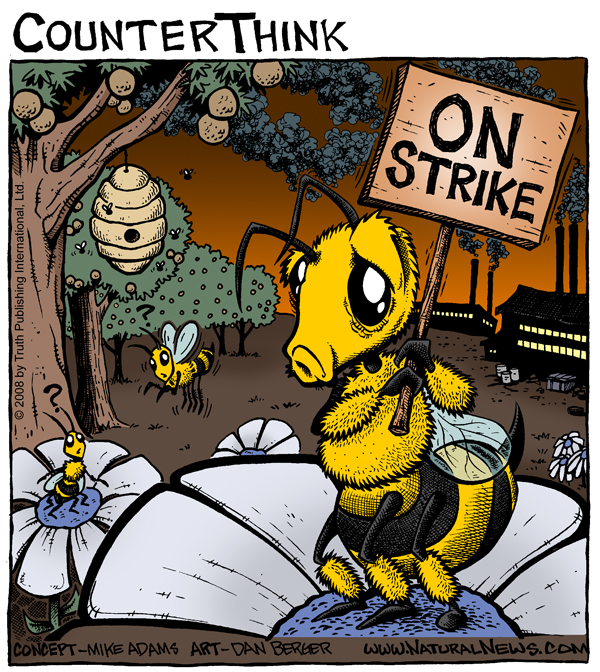
I tend to think that honeybees are simply "on strike." They're tired of being slave workers for the very humans who continue to destroy their habitat, pollute their air and water, and steal the labors of their hard work (honey, bee pollen and free pollination services).
Honeybees pollinate 130 different crops, which supply $15 billion worth of food and ingredients each year. One out of every three bites of food on your dinner plate was made possible by honeybee pollination.
The Emergence of Colony Collapse Disorder
In late 2006, beekeepers in the United States began to notice that unusual numbers of honeybees were dying during the winter. Beekeepers reported losing between 30 and 90 percent of their bees, in contrast to the usual 20 to 25 percent.
The phenomenon, which continued through last winter, remains unexplained. Some of the potential reasons being investigated for the honeybee die-off are poor nutrition, invasive mites, diseases or toxins, air pollution, or a mysterious phenomenon known as colony collapse disorder, in which bees abruptly desert their hives and die (i.e. they go on strike). In general,
human beings have a very poor appreciation of all the services "provided" by Mother Nature, including the removal of CO2 from the air by plants, the turning of soil by worms, and of course the free pollination of crops and orchards by
honeybees and other insects.
While the U.S. Department of Agriculture's Agricultural Research Service (ARS) and a number of institutions are currently researching the causes of the die-off, the food industry is now entering the fray. International ice-cream giant Haagen-Dazs has announced a new program to fund and encourage research into the problem, with the hopes of staving off a crisis for its own business.
"Haagen-Dazs
ice cream is made from the finest all-natural ingredients, and the plight of the honeybee could mean many of the ingredients used in our top flavors, like Vanilla Swiss Almond and Strawberry, would be difficult to source," said Haagen-Dazs brand manager Josh Gellert.
Nearly 40 percent of Haagen-Dazs' ice cream flavors include bee-dependent ingredients. "These are among consumers' favorite flavors," brand director Katty Pien said. "We use 100 percent all-natural ingredients like strawberries, raspberries and almonds which we get from California. The bee problem could badly hurt supply."
The "Haagen-Dazs Loves Honeybees" (HD loves HB) campaign includes the creation of a board of bee scientists to help guide research into the problem, a $150,000 grant to honeybee-related programs at Penn State's College of Agricultural Sciences and a $100,000 grant to the Harry H. Laidlaw Jr. Honeybee Research Facility at the University of California-Davis
"Honeybees are in trouble," said Walter Leal, professor chair of the UC-Davis Entomology Department. "One-third of our nation's
food supply depends on bee pollination, but bees are vanishing in massive numbers. This gift will help us to rebuild and revitalize our honeybee program."
The Laidlaw program suffered greatly from budget cuts and faculty retirements during the 1990s, before colony collapse emerged as a problem. The Haagen-Dazs grant will go toward a postdoctoral researcher's salary and toward funding research into
colony collapse disorder and sustainable pollination.
At Penn State, the grant money will help purchase equipment that will be used to analyze samples and more effectively detect and identify viruses, pesticides and other potentially harmful substances. It will also fund small student research grants.
Beyond ice cream: The coming era of food scarcity
Of course, the honeybees-on-strike problem goes way beyond ice cream. We're talking about one-third of the human food supply here. If honeybees stop doing all the free work they've been doing to pollinate crops, humans are going to find themselves in very difficult situation regarding global food supplies. A global famine is not out of the question here, especially when you combine the loss of honeybee populations with the situation of rapidly deteriorating soil quality across the world's farmlands. Without usable soils and willing insect
pollinators, humans will quickly find themselves chewing on their shoelaces, wishing they could bring back the "good days" when honeybees freely volunteered to work, and farm soils actually contained nutrients.
In my view, the collapse of honeybee populations is just one sign of many that humans have pushed Earth's ecosystems over the edge. We've polluted the skies, the land and the waters. We've raped the planet of its minerals, slashed and burned its rainforests, depleted its soils and devastated its wild animal population. We've dumped chemicals, radioactive waste and endless mountains of trash into the oceans and waterways. And then we balk when nature hiccups. We scratch our heads, wondering why some element in nature that we've exploited for so long suddenly stops behaving in the way we want. Why are the ocean fish populations collapsing? Why are our food crops nutritionally depleted? Why are infectious diseases now threatening to unleash a new pandemic? Why are honeybees going on strike?
The answer, of course, is
because humans have turned planet Earth into a toxic world. We've poisoned the one thing in the universe that openly and unselfishly offered to give us so much for free. Yet instead of appreciating Mother Nature, we've chosen to betray her. We've turned what was once an Eden into a toxic world, and it's only a matter of time before the destabilizing, harmful practices we've adopted to feed an expanding human population come back to haunt us in a devastating way.
There is a tipping point where Mother Nature will simply refuse to cooperate, and this honeybee collapse is one sign that we may have already crossed a threshold, beyond which balance will only be achieved by a sharp decline in the human population.
Not coincidentally, the loss of food pollinators will cause precisely that. As I've said many times before on NaturalNews, eventually humans will live in balance with nature. The question is whether we will consciously create that balance as a mature species, or if we will be starved into submission by a global ecosystem that refuses to support such a large population of human beings. One thing for sure: The problem of rampant obesity is about to come to an end. A few years from now, the very idea that half the people in any nation could feed themselves into a state of extreme obesity will be considered outlandish.
The alarm bells are ringing, folks. We have reached the limit of the planet's ability to absorb our pollution and environmental devastation. I sadly predict the human species if not mature enough to make the necessary forward-thinking changes, and that it will only learn from disaster. That disaster is coming. Prepare to live in a world where food becomes desperately scarce. Prepare to see the human population collapse in almost precisely the same way the honeybee populations are collapsing.
As go the insects, so go humans.
Permissions to use: Want to use this cartoon? Specific, limited permission is granted to reprint in any book, movie, website, magazine, newspaper, animation or other media under the following 'professional courtesy' conditions:
- Cartoon creator Mike Adams must be conspicuously credited.
- Web address www.NaturalNews.com must be posted below or adjacent to the cartoon in a conspicuous manner. If on the web, the link must be clickable.
- You may not use this cartoon in a disparaging context or manner.
- You may not charge for this cartoon.
- Truth Publishing retains all ownership, rights and copyrights.
- Reprint rights may be revoked, without notice, on a case by case basis, if reprint courtesy is, in our opinion, abused.
High-resolutions files are available for film and print.







 Monday, May 12, 2008
 Email this article to a friend
 Printable Version





 Email this article to a friend
 Share this article on: