



Protein Economics: The Cost of Meeting the Minimum Daily Requirements
Friday, February 22, 2008 by: John M. Yarlott
Tags: essential amino acids, dietary protein, health news
- The 5 best natural antibiotics and anti-virals that destroy superbugs and just about everything else
- The REAL FAKE NEWS exposed: '97% of scientists agree on climate change' is an engineered hoax... here's what the media never told you
- Eighteen Overlooked Symptoms of Adrenal Fatigue
- Home remedies from herbal teas and grocery foods dissolve kidney stones and reverse renal failure
- INVESTIGATION: Three days before Dr. Bradstreet was found dead in a river, U.S. govt. agents raided his research facility to seize a breakthrough cancer treatment called GcMAF
- Serrapeptase is an Inexepensive Natural Miracle Medication
- Insider memo reveals US unemployment rate exceeding 37 percent; 'Misery Index' worst in 30 years
- 'Never has there been a safe vaccine,' Suzanne Humphries, MD, says in interview
- Organic sulfur crystals are a miracle food that provides amazing health benefits
- Natural News Labs publishes heavy metals test results for seaweeds and sea vegetables: Kelp, Kombu, Wakame, Nori, Dulse and more
- Bicarbonate of Soda Used to Cure Stage Four Prostate Cancer
- Ten Top Items: Address Ulcerative Colitis Naturally
- Royal Rife: Cancer Cure Genius Silenced by Medical Mafia
- Institute of Medicine adverse reactions report admits MMR vaccines cause measles, seizures, anaphylaxis and other health problems
- If you or a loved one is taking Prozac, consider switching to cashews instead (yes, cashews!)
- Vaccines lower immunity
- Bill Gates says vaccines can help reduce world population
- Health Basics: When is organic still GMO?
- Home remedies from herbal teas and grocery foods dissolve kidney stones and reverse renal failure
- Lack of Forgiveness Can Affect Our Health
- Organic sulfur crystals are a miracle food that provides amazing health benefits
- The REAL FAKE NEWS exposed: '97% of scientists agree on climate change' is an engineered hoax... here's what the media never told you
- Eighteen Overlooked Symptoms of Adrenal Fatigue
- The best and worst forms of magnesium to take as a supplement
- The United Nations 2030 Agenda decoded: It's a blueprint for the global enslavement of humanity under the boot of corporate masters
- Bill Gates says vaccines can help reduce world population
- Simple exercises to improve your eyesight naturally
- Apricot Seeds Kill Cancer Cells without Side Effects
- Top 10 inexpensive food items that can PREVENT nearly every disease and disorder known to mankind
- Before his death, father of ADHD admitted it was a fictitious disease
- The new statin drug scam: Half the doctors on the recommendation panel have Big Pharma ties
- Chaparral is natural medicine for treating cancer
- The 5 best natural antibiotics and anti-virals that destroy superbugs and just about everything else
- 'Never has there been a safe vaccine,' Suzanne Humphries, MD, says in interview
- Bicarbonate of Soda Used to Cure Stage Four Prostate Cancer
- How to Detox Fluorides from Your Body
- The REAL FAKE NEWS exposed: '97% of scientists agree on climate change' is an engineered hoax... here's what the media never told you
- Peanut oil in vaccines behind widespread peanut allergy epidemic
- Home remedies from herbal teas and grocery foods dissolve kidney stones and reverse renal failure
- Lack of Forgiveness Can Affect Our Health
- Forget Filling Cavities: Regrow Your Teeth Instead
- The United Nations 2030 Agenda decoded: It's a blueprint for the global enslavement of humanity under the boot of corporate masters
- Bill Gates says vaccines can help reduce world population
- The best and worst forms of magnesium to take as a supplement
- 'Never has there been a safe vaccine,' Suzanne Humphries, MD, says in interview
- Apricot Seeds Kill Cancer Cells without Side Effects
- How to Detox Fluorides from Your Body
- Ten reasons why you shouldn't vaccinate your children
- Eighteen Overlooked Symptoms of Adrenal Fatigue
- Beat cancer with 35% hydrogen peroxide
- Global warming data FAKED by government to fit climate change fictions
- Canola oil: a chemical carcinogen that doesn't belong anywhere near your food
- Boost Low White Blood Cell Count and Immune Function Naturally
- Colorado Batman shooting shows obvious signs of being staged
- The REAL FAKE NEWS exposed: '97% of scientists agree on climate change' is an engineered hoax... here's what the media never told you
- Beat cancer with 35% hydrogen peroxide
- The best and worst forms of magnesium to take as a supplement
- The United Nations 2030 Agenda decoded: It's a blueprint for the global enslavement of humanity under the boot of corporate masters
- Apricot Seeds Kill Cancer Cells without Side Effects
- Bill Gates says vaccines can help reduce world population
- Forget Filling Cavities: Regrow Your Teeth Instead
- The MMR vaccine, autism connection
- Six little-known natural remedies for tinnitus
- Supplements to detox the body from vaccinations
- Reverse and eliminate cataracts naturally without surgery
- What's really in vaccines? Proof of MSG, formaldehyde, aluminum and mercury
- Dandelion root extract found to kill leukemia cells, prostate cancer cells and chemo-resistant melanoma
- Peanut oil in vaccines behind widespread peanut allergy epidemic
- High-dose vitamin C injections shown to annihilate cancer
- Eighteen Overlooked Symptoms of Adrenal Fatigue
- Indian black salve: The magical cancer cure
- INVESTIGATION: Three days before Dr. Bradstreet was found dead in a river, U.S. govt. agents raided his research facility to seize a breakthrough cancer treatment called GcMAF





The report also shows that the minimum amount of protein required for nitrogen replacement is approximately proportional to the basal metabolism, i.e. the daily number of kilocalories (KCAL) burned doing work and normal bodily functions. In addition to the amount of physical work done by people, the KCAL burned depend on the person's gender, age, height, and weight. "It is important to maintain adequate KCAL to achieve minimal protein utilization and minimal nitrogen excretion," according to Dr. Hegsted, the author of the above mentioned report.
In another report there is this statement: "Around the world, millions of people don't get enough protein. Protein malnutrition leads to the condition known as kwashiorkor. Lack of protein can cause growth failure, loss of muscle mass, decreased immunity, weakening of the heart and respiratory system, and death" (http://www.hsph.harvard.edu/nutritionsource/...) .
And also this message: "Can you get too much protein? Digesting it releases acids that the body usually neutralizes with calcium and other buffering agents in the blood. Eating lots of protein, such as the amounts recommended in the so-called low-carb or no-carb diets, takes lots of calcium. Some of this may be pulled from bone. Following a high-protein diet for a few weeks probably won't have much effect on bone strength. Doing it for a long time, though, could weaken bone. In the Nurses' Health Study, for example, women who ate more than 95 grams of protein a day were 20 percent more likely to have broken a wrist over a 12-year period when compared to those who ate an average amount of protein - less than 68 grams a day (1). Although more research is clearly needed to define the optimal amount of daily protein, these results suggest that long-term high-protein diets should be used with caution, if at all."
We get our protein from the consumption of foods which brings us to the point of my article. How much does the food we need for protein cost, and which foods are the most economical? Some foods are high in protein and we can get by with smaller portions while others are low in protein, so we need more. This study compares types of food on the basis of the minimum quantity needed to provide adequate protein and the associated cost. On any given day, where the minimum protein has been or is expected to be consumed, the associated calories may be subtracted from the daily KCAL requirement to determine the additional calories to be consumed using additional foods.
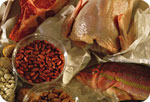
For example, seafood is high in protein and for a 2000 calorie diet requiring 33 grams of protein a day, a 4.8 ounce serving of whitefish would cost $1.19 a day. While a 3.5 ounce serving of skinless chicken breast for the same diet would cost only 43 cents per day. I have collected price, calorie, and protein data for a list of 67 foods. The above computations were made for each food on the list. The entire list is available at (http://www.jmyarlott.com/food/protein) where there is a protein calculator to find your daily KCAL and protein requirements. The values in the food table will be personalized according to your required minimum protein requirements.
As previously noted, in addition to meeting our daily requirements for protein, we also need to maintain the proper caloric intake to support our body size and lifestyle. The calories in the fish serving would be 232 while the calories in the chicken serving would be 184. In each case, the additional calories would come from additional foods. The average cost per calorie of the 67 foods in my list is $.00721. So in the case of the fish, one would have to make up 2000 minus 232 (or 1768) calories at an average cost of $12.75 (.00721 times 1768) for a total of $13.94 per day. In the case of the chicken, one would make up (2000 minus 184) or 1816 calories at an average cost of $13.09 for a total of $13.52 per day. These calculations were run for each of the 67 foods.
The high, low and median daily costs for several KCAL values follow:
1) For 1500 CAL the median daily cost is $9.53, the maximum is $23.76, the minimum is $1.00*
2) For 2000 CAL the median daily cost is $13.14, the maximum is $27.36, the minimum is $4.47
3) For 2500 CAL the median daily cost is $16.74, the maximum is $30.97, the minimum is $8.07
4) For 3000 CAL the median daily cost is $20.35, the maximum is $34.57, the minimum is $11.68
5) For 3500 CAL the median daily cost is $23.95, the maximum is $38.17, the minimum is $15.28
* A single large baked potato provides all the necessary daily protein and calories at this basal metabolism level.
The protein foods that come close to the median cost are the meats and dairy, the highest cost protein foods are veggies and soy milk and the lower cost protein foods are nuts, rice, and potatoes.
The protein amount was obtained form food labels and also this website (http://www.thecaloriecounter.com) . Caloric content for the food was obtained as well. Prices were obtained from the internet and from grocery stores. Food prices change over time, usually upward. Nevertheless these results were valid for comparing the food costs. Some foods are more acceptable than others based on factors other than cost and protein quality. In those cases, I have included anecdotal information when available
For those who want to have the data applicable to their own metabolism, please go to (http://www.jmyarlott.com/food/protein/) where you can obtain a personalized table of foods designed to fit your metabolism. There is a calculator to find your metabolism and the food table will automatically be adjusted to that level.
About the author
John Yarlott developed his writing skills during his career as a Mechanical Engineer with Pratt & Whitney Aircraft. His work included testing jet engines and writing the test reports for use by the design and management groups. He later worked at IBM as writer of guides for computer design. He ran technical symposiums and published the hundreds of technical reports on computer packaging. John was also a store systems engineer in IBM marketing where he wrote computer programs for customers that generated reports based on transaction data in the checkout terminals. John’s last assignment before retiring was as a technical support engineer for IBM’s database software. During retirement he wrote training manuals for Microsoft Office Products at Hill & Knowlton, a division of WPP. He wrote web based data acquisition programs that captured human resources data in a MS Access database. The firm had offices in 52 countries therefore using the Internet to communicate with the database in New York was a time saving solution. Now retired for the second time, John has turned his attention to web publishing about matters of his own interest including health, nutrition, food economics, and global energy on his personal website: http://jmyarlott.com .


Essential amino acids at FETCH.news
Get independent news alerts on natural cures, food lab tests, cannabis medicine, science, robotics, drones, privacy and more.

Take Action: Support Natural News by linking to this article from your website
Permalink to this article:
Embed article link: (copy HTML code below):
Reprinting this article:
Non-commercial use OK, cite NaturalNews.com with clickable link.
Follow Natural News on Facebook, Twitter, Google Plus, and Pinterest

Science News & Studies

Medicine News and Information

Food News & Studies

Health News & Studies

Herbs News & Information

Pollution News & Studies

Cancer News & Studies

Climate News & Studies

Survival News & Information

Gear News & Information

News covering technology, stocks, hackers, and more






"Big Tech and mainstream media are constantly trying to silence the independent voices that dare to bring you the truth about toxic food ingredients, dangerous medications and the failed, fraudulent science of the profit-driven medical establishment.
Email is one of the best ways to make sure you stay informed, without the censorship of the tech giants (Google, Apple, Facebook, Twitter, YouTube, etc.). Stay informed and you'll even likely learn information that may help save your own life."
–The Health Ranger, Mike Adams