



Eating Foods High in Plant Sterols Reduces Cholesterol Naturally
Friday, March 21, 2008 by: John M. Yarlott
Tags: plant sterols, health news, Natural News
- The REAL FAKE NEWS exposed: '97% of scientists agree on climate change' is an engineered hoax... here's what the media never told you
- Vitamin B-12 warning: Avoid cyanocobalamin, take only methylcobalamin
- Prevent Myopia, Part II: The Importance of Prevention
- New documentary shines light onto CDC's cover-up of links between vaccines and autism
- The best and worst forms of magnesium to take as a supplement
- NASA admits to spraying Americans with poisonous chemtrails
- Why milk is bad for you
- Dr. Gabriel Cousens reveals method for reversing diabetes with raw living foods in exclusive interview
- Rejuvenate Plus superfood is high in DNA and RNA with sprouts, chlorella and more
- Naturally Prevent and Remove Dangerous Arterial Plaque
- Ancestry.com colludes with police to share your genetic information in violation of privacy rights
- BP top kill method fails as cleanup workers are hospitalized from vapors
- How I cured diabetes in five steps, and why one-third of U.S. adults will have diabetes by 2050
- Fast food marketing targets black children in US
- Beat cancer with 35% hydrogen peroxide
- Nine cancer cures that the Medical Mafia doesn't want you to know about
- Ten Natural Ways Grow Hair and Reduce Hair Loss
- Low sulfur nutrition plan
- The REAL FAKE NEWS exposed: '97% of scientists agree on climate change' is an engineered hoax... here's what the media never told you
- FBI agents now impersonating Associated Press reporters
- Eighteen Overlooked Symptoms of Adrenal Fatigue
- The eight best home remedies and holistic treatments to relieve tinnitus and ringing in the ears
- Apricot Seeds Kill Cancer Cells without Side Effects
- Beat cancer with 35% hydrogen peroxide
- The Gerson Therapy: Big Pharma and the AMA Suppress Another Holistic Cancer Cure
- Skynet rising: Google acquires 512-qubit quantum computer; NSA surveillance to be turned over to AI machines
- Six little-known natural remedies for tinnitus
- Not Just a Beautiful Flower: The Marigold Brings Natural Health
- Should you consume soy products?
- Irrefutable proof we are all being sprayed with poison: 571 tons of toxic lead 'chemtrailed' into America's skies every year
- Ten reasons why you should have warm lemon or lime water daily
- GMOs are dangerous to our health, according to latest independent research
- CoQ10 helps heal neurodegenerative disease: Study
- More than 95% accurate, this early detection cancer test could save your life without the risk of radiological screenings
- Evidence-based vaccinations: A scientific look at the missing science behind flu season vaccines
- Coconut Oil is More Efficacious for Alzheimer's than All Big Pharma has to Offer
- The REAL FAKE NEWS exposed: '97% of scientists agree on climate change' is an engineered hoax... here's what the media never told you
- Six little-known natural remedies for tinnitus
- INVESTIGATION: Three days before Dr. Bradstreet was found dead in a river, U.S. govt. agents raided his research facility to seize a breakthrough cancer treatment called GcMAF
- The United Nations 2030 Agenda decoded: It's a blueprint for the global enslavement of humanity under the boot of corporate masters
- The eight best home remedies and holistic treatments to relieve tinnitus and ringing in the ears
- Bill Gates says vaccines can help reduce world population
- Use Homeopathic Gout Remedies: Colchicum, Ledum, Nux Vomica and Aconite
- Eighteen Overlooked Symptoms of Adrenal Fatigue
- The best and worst forms of magnesium to take as a supplement
- Apricot Seeds Kill Cancer Cells without Side Effects
- FBI agents now impersonating Associated Press reporters
- Top six alkaline foods to eat every day for vibrant health
- BREAKING: CDC whistleblower confesses to MMR vaccine research fraud in historic public statement
- MRSA superbug may be spread through contaminated poultry
- Publicly funded GMO research in India exposed as fraud to secretly sneak in Monsanto seeds
- Tetanus vaccines found spiked with sterilization chemical to carry out race-based genocide against Africans
- Forget Filling Cavities: Regrow Your Teeth Instead
- Make Your Own Vitamin B Complex: Save Money and Ignore Supplement Restrictions
- Eleven days before Iran bombed Tel Aviv, my microscope revealed haunting images of EXACTLY what would happen
- Morphic resonance “remote viewing” reveals iconic Middle East images of stealth bombers, a falcon and a one-horned ram
- DECENTRALIZED SPIRITUALITY and the true teachings of Christ: Overcoming the censorship, threats and lies of organized religion to truly know God and the Universal Christ
- HEALTH SECRETS: How to Instantly Block MSG Toxicity Using Natural Substances (and the secret of Methylene Blue)
- Amazing microscopy photos reveal how freezing crystals attempt to mimic electronic structures they are touching
- The Coming Gold Revaluation: Strategic Financial Realignment in an Era of Dollar Collapse
- The AI Data Center Wars Have Begun… Farms, Water and Electricity is Stripped from Humans to Power the Machines
- Urgent Wake-Up Call: The Coming AI Robot Wars and the Great Human Unity
- The War on Light: How Governments and Big Pharma Keep You Sick By Blocking Healing Photons
- BOMBSHELL: Internal Pfizer documents exposed and reveal at least 16 PERCENT of their mRNA vaccine "adverse events" are REPRODUCTIVE DISORDERS
- THE AI RACE IS ALREADY WON: How China’s power dominance (and America’s climate lunacy surrender) secured its victory in the race to AI superintelligence
- Why the U.S. Government May be Seeking to Slaughter 200 Million Americans to Free Up Excess Power for AI Data Centers and the Race to Superintelligence
- Trump's Trojan Horse: How Stablecoins Are Secretly Paving the Way for a CBDC Control Grid – an Interview with Catherine Austin Fitts
- Newly released JFK files reveal Pentagon's role in creating Lyme disease and covid in the same lab
- EXCLUSIVE REPORT: The Trump-Putin Meeting in Alaska - A Historic Pivot that Redefined Global Power
- MSG EXPOSED: Hidden Neurotoxins Found in Groceries, Snacks and Popular Fast Food Menus
- Doctors are still puzzled about “long vax,” a set of symptoms linked to COVID-19 vaccines
- BOMBSHELL: DNA testing kits are a SCAM to develop ethnic-specific bioweapons





Phytosterols (http://en.wikipedia.org/wiki/Phytosterol) , also known as plant sterols, are essential components of plant membranes that perform functions for plants similar to that of cholesterol in humans. Phytosterols in the foods we eat are believed to block cholesterol absorption sites in the human intestine thus helping to reduce cholesterol.
The International Food Information Council (http://www.ific.org/publications/factsheets/...) has published an article that provides positive information on the use of plant sterols and stanols summarized as follows: "Foods and beverages supplemented with plant sterols/stanols may reduce cholesterol and are a promising addition to interventions aimed at lowering heart disease risk. Maximum effects are observed at plant sterol/stanol intakes of approximately two to three grams per day. The level of LDL cholesterol reduction ranges between 6 to 15 percent. A growing body of scientific evidence also suggests other positive health outcomes that include the reduced risk of certain types of cancer."
In one clinical trial (http://www.ajcn.org/cgi/content/abstract/81/...) the abstract states "Plant sterol consumption significantly reduced (P < 0.05) LDL-cholesterol concentrations from baseline in both nondiabetic and diabetic subjects by 15.1% and 26.8%, respectively. The diabetic subjects had significantly (P < 0.05) lower absolute concentrations of total cholesterol after treatment than did the nondiabetic subjects; however, there was no significant difference in the percentage change from the beginning to the end of the trial. There was also a significant decrease (P < 0.05) in absolute non-HDL-cholesterol concentrations after treatment in both groups.
In another article, the author stated that 1.8g per day of phytosterols reduced blood cholesterol up to 12%. There are several types of plant sterols: beta sitosterol, avenasterol, and campesterol to name a few. Another source (http://www.olivado.com/studies2.htm) gives the daily requirements of beta sitosterol as 2g in order to reduce serum cholesterol 10-20%.
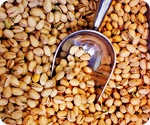
A recent article in Science Daily entitled "Pistachios Lower Cholesterol; Provide Antioxidants" (http://sciencedaily.com/releases/2007/04/070...) discusses a clinical trial at Penn State University. The participants experienced blood cholesterol reductions of 8.4 to 11.6 percent after eating 3 ounces (85.05g) of pistachios on a Step I Diet for two weeks.
In another study, the subjects were fed wheat germ either with or without phytosterols. The study showed a 42% reduction in blood cholesterol in those with the phytosterols as opposed to those without. The authors who reported this study included a list of foods and their phytosterol content. Using their list and the USDA nutrient database, I have created a chart for 18 high phytosterol foods that shows the amount of each food that would achieve comparable results as those achieved with the pistachio diet with respect to the lowering of cholesterol. Note that Oils generally require less amounts and nuts and legumes require moderately higher amounts of a given food. Other plant foods require much higher amounts and were excluded from the chart. See High Phytosterol Foods (http://jmyarlott.com/amount.asp) .
References:
ScienceDaily.com (http://www.sciencedaily.com/releases/2007/04...)
DietaryFiberfood.com (http://www.dietaryfiberfood.com/cholesterol-...)
American Chemical Society (http://pubs.acs.org/cgi-bin/abstract.cgi/jaf...)
Nutraingredients.com (http://nutraingredients.com/news/printnewsbi...)
Naturalnews.com (https://www.naturalnews.com/016596.html)
USDA Nutrient Data Laboratory (http://www.nal.usda.gov/fnic/foodcomp/search...)
Foreign Agricultural Service Labeling Requirements (http://useu.usmission.gov/agri/label.html)
Olivado Natural Nutrition (http://www.olivado.com/studies2.htm)
International Food Information Council (http://www.ific.org/publications/factsheets/...)
About the author
John Yarlott developed his writing skills during his career as a Mechanical Engineer with Pratt & Whitney Aircraft. His work included testing jet engines and writing the test reports for use by the design and management groups. He later worked at IBM as writer of guides for computer design. He ran technical symposiums and published the hundreds of technical reports on computer packaging. John was also a store systems engineer in IBM marketing where he wrote computer programs for customers that generated reports based on transaction data in the checkout terminals. John’s last assignment before retiring was as a technical support engineer for IBM’s database software. During retirement he wrote training manuals for Microsoft Office Products at Hill & Knowlton, a division of WPP. He wrote web based data acquisition programs that captured human resources data in a MS Access database. The firm had offices in 52 countries therefore using the Internet to communicate with the database in New York was a time saving solution. Now retired for the second time, John has turned his attention to web publishing about matters of his own interest including health, nutrition, food economics, and global energy on his personal website: http://jmyarlott.com .


Plant sterols at FETCH.news
Get independent news alerts on natural cures, food lab tests, cannabis medicine, science, robotics, drones, privacy and more.

Take Action: Support Natural News by linking to this article from your website
Permalink to this article:
Embed article link: (copy HTML code below):
Reprinting this article:
Non-commercial use OK, cite NaturalNews.com with clickable link.
Follow Natural News on Facebook, Twitter, Google Plus, and Pinterest

Science News & Studies

Medicine News and Information

Food News & Studies

Health News & Studies

Herbs News & Information

Pollution News & Studies

Cancer News & Studies

Climate News & Studies

Survival News & Information

Gear News & Information

News covering technology, stocks, hackers, and more






"Big Tech and mainstream media are constantly trying to silence the independent voices that dare to bring you the truth about toxic food ingredients, dangerous medications and the failed, fraudulent science of the profit-driven medical establishment.
Email is one of the best ways to make sure you stay informed, without the censorship of the tech giants (Google, Apple, Facebook, Twitter, YouTube, etc.). Stay informed and you'll even likely learn information that may help save your own life."
–The Health Ranger, Mike Adams