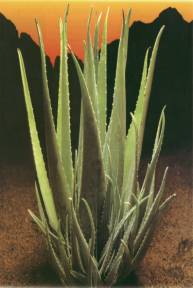
Aloe vera is one of my favorite healing plants, and I believe it is quite promising in terms of enhancing cardiovascular health. This is a subject that hasn't had many studies conducted yet, but there has been some related research that I think sheds light on the issue. For example, it is now known that an extract from aloe vera gel, when injected into the human bloodstream, greatly multiplies the oxygen transportation and diffusion capabilities of red blood cells.
In other words, if a patient is losing a tremendous amount of blood, such as a soldier who is wounded on the battlefield, and perhaps they've lost several pints of blood and their blood stores are getting dangerously low, they can be injected with a very small amount of extract taken from the aloe vera plant. This extract will then quickly diffuse through the bloodstream and multiply the effectiveness of the blood remaining in that person's system.
Effectively, this aloe vera extract makes that blood that's left in the body function as if it were a full supply of blood. It delivers oxygen more efficiently to the organs in the body that need oxygen to stay alive, most notably the brain and the heart. This has been well proven, and in fact aloe vera extract is now a part of a first aid medical product that is being marketed to the U.S. military for precisely this purpose. I've covered it in other articles here on this web site.
But the question is how does aloe vera actually do this? This is just an educated guess on my part, but it seems to me that aloe vera accomplishes this by increasing the viscosity of human blood. In order words, a normal person walking around day to day with normal blood of average health has a certain amount of stickiness in their red blood cells. The blood cells tend to stick together. This is not necessarily clotting, but it's just blood stickiness. In fact, you can see it under a microscope if you look at the blood of an unhealthy person versus a healthy person. The blood of an unhealthy person will tend to group together in small clusters, whereas the blood of a healthy person will tend to be free-flowing with individual red blood cells moving independently
Now, obviously the surface area of red blood cells is going to be far greater when each blood cell can move independently. And the surface area is directly related to the diffusion capability of red blood cells. In other words, the greater the surface area, the faster oxygen can move into red blood cells and be carried by the hemoglobin (the oxygen-carrying molecule in human blood). At the same time, once those red blood cells reach their destination in the body, the more surface area is available and the faster the oxygen can move out of the hemoglobin and be absorbed by the tissues that need that oxygen to operate.
If you use aloe vera and you increase the viscosity of red blood cells, then you effectively take a quantity of red blood cells that wasn't functioning at its optimum efficiency and transform them into something very efficient. You effectively increase the working surface area of the entire blood supply. And that explains exactly why this extract can help a hemorrhaging patient who has lost a tremendous amount of blood continue to live and function even on a much smaller volume of blood.
What does all of this mean to you as a person who might be a heart patient or a person with atherosclerosis who is looking to enhance your cardiovascular health? It means simply that if you eat aloe vera gel, which is something that I do on a daily basis, then you may be doing yourself a huge favor in terms of your cardiovascular health. Very likely you are increasing the viscosity of your blood at the cellular level. You're increasing its ability to carry oxygen, and to diffuse that oxygen into the organs in your body.
Theoretically, by increasing the viscosity, you are effectively halting the plaque buildup in your arteries, because there aren't groups of red blood cells floating around in your system that get stuck on the micro tears and abrasions that appear along the walls of your arteries. So blood viscosity works in your favor and aloe vera, I believe, will some day be scientifically proven to be a healing plant that vastly improves blood viscosity.
About the author: Mike Adams is a natural health researcher, author and award-winning journalist with a passion for teaching people how to improve their health He is a prolific writer and has published thousands of articles, interviews, reports and consumer guides, and he has published numerous courses on preparedness and survival, including financial preparedness, emergency food supplies, urban survival and tactical self-defense. Adams is an honest, independent journalist and accepts no money or commissions on the third-party products he writes about or the companies he promotes. In 2010, Adams co-founded NaturalNews.com, a natural health video sharing site that has now grown in popularity. He also launched an online retailer of environmentally-friendly products (BetterLifeGoods.com) and uses a portion of its profits to help fund non-profit endeavors. He's also a veteran of the software technology industry, having founded a personalized mass email software product used to deliver email newsletters to subscribers. Adams also serves as the executive director of the Consumer Wellness Center, a non-profit consumer protection group, and practices nature photography, Capoeira, martial arts and organic gardening. He's also author a large number of health books offered by Truth Publishing and is the creator of numerous reference website including NaturalPedia.com and the free downloadable Honest Food Guide. His websites also include the free reference sites HerbReference.com and HealingFoodReference.com. Adams believes in free speech, free access to nutritional supplements and the innate healing ability of the human body.

Have comments on this article? Post them here:
people have commented on this article.




 Sunday, December 05, 2004


 Email this article to a friend